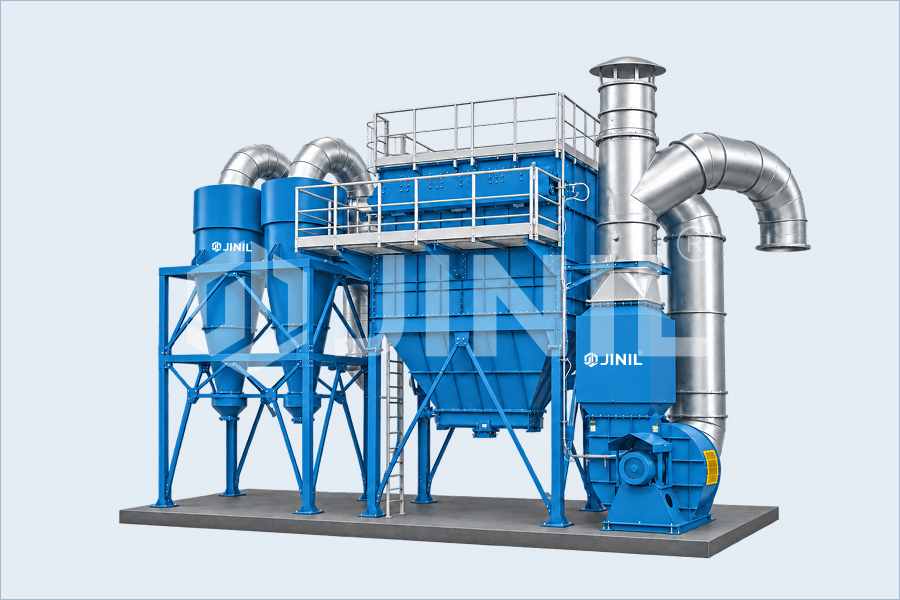
At Jinil, the dust collector isn’t an add-on. We manufacture blasting machines and their dust collection systems, so our team plans both together from the start. Whether it’s a wheel blast line, a blast room, or a small cabinet, the collector is designed around the machine it serves. Need a dust collector for sand blasting? Tell us what you blast, which abrasive you use, and how long the machine runs, and we’ll work out the right filters from there. Our service team doesn’t walk away after handover either. Filter changes, spares, AMCs, and 24/7 support are all part of it.
Smart Process Overview
When a Jinil dust collection system for sandblasting is running, it starts with suction. The fan pulls the dusty air away from the blasting area, down the ducts, and into the collector.
Inside, filtration takes place. The air goes through the cartridges or bags, which catch the dust and let the filtered air through. At set intervals, filter cleaning happens, when a short jet of air knocks the built-up dust off.
For dust collection, gravity does the rest, and the dust falls into the bin underneath. The filtered air then leaves through the exhaust as clean air out, as per your installation.
Jinil makes blasting machines, so our dust collectors are designed by the same team that builds the machine they serve. Each shot blasting machine and dust collector setup is planned as one system, built in our own factory and supported by our service team long after installation.
The collector is matched to your machine, with airflow and filters sized for your blasting setup. We supply collectors for airless and air-operated machines, including wheel blast lines, blast rooms, and cabinets. It is built-in, not bolted on, so the collector is part of the plan from day one and not something added later. With in-house manufacturing, every collector is made in our own workshop. Even years after installation, our after-sales care is a call away for filters, spares, or an AMC.
It begins with Requirement Analysis, where we look at your blasting machine, abrasive, and working hours. Then, in Collector Design, our team picks the collector type, filter area, and fan size. The last stage is Installation and Commissioning, where we install the collector, connect the ducting, and test the suction.
There’s no fixed price for a dust collector. Shot blasting machine size, airflow, filter type, and duct length all affect the cost, so we quote based on your machine and shop layout.

Industrial Solutions
Jinil’s sandblasting dust collection system setups are used with:
Wheel blast machines: Tumblast, hanger, roller conveyor, and table machines all produce steady dust that needs constant extraction.
Blast rooms: The operator works inside the room, so clear air matters for both visibility and safety.
Blast cabinets: A sand blast cabinet with dust collector keeps the window clear and the workbench clean.
Pipe and structural steel lines: Long parts mean long cycles, and the collector has to keep up the whole time.
Foundries and forging shops: Castings come out of the mould with sand stuck to them, and forgings carry heavy scale. Blasting either one makes a lot of dust, fast.
Industrial Solutions
A Jinil collector makes a clear difference on the shop floor:
Advanced Engineering Highlights
Here’s what goes into a Jinil shot blasting machine dust collector:
These collectors are built as part of Jinil’s blasting systems, and our team picks the type based on your machine, abrasive, and running hours:
Cartridge Dust Collector: Pleated cartridges pack plenty of filter area into a small unit. It’s a good fit for blast cabinets and compact wheel machines.
Bag Filter Dust Collector: Long fabric bags handle large volumes of air. Plants with big wheel blast lines or blast rooms usually go for this one.
Cabinet Dust Extractor: This is a small unit made for air-operated blast cabinets, often called a blast cabinet dust extractor.
Even a good collector loses suction if the filters are left too long. Our service team helps keep yours working properly:
Filter replacement: Worn cartridges or bags? We’ll bring the right ones for your unit and fit them on site.
Routine checks: On each visit, our team checks the fans, valves, pulse-jet system, and pressure gauge.
Leak and duct checks: Even a small gap in a duct or joint can cut your suction. Our team checks for these and seals them.
AMCs: With an annual maintenance contract, we plan the visits for you, so you don’t have to keep track of them.
Upgrades: Running more parts than before? Our team can fit bigger filters or a stronger fan to the collector you already have.
It’s a filter unit connected to a blasting machine. As long as the machine is blasting, the shot blasting dust collector draws out the dusty air, keeps the dust in its filters, and lets the filtered air go.
Air from the blast chamber is pulled into the collector by a fan, through a set of ducts. The dust gets caught on cartridge or bag filters, and bursts of compressed air shake it loose into a bin below. The filtered air is then released.
There’s less dust in the air around the machine, operators can see what they’re blasting, and less dust settles on parts. It also helps reduce dust-related wear inside the machine.
It’s the full setup that removes dust during sandblasting: the fan, ducting, filters, and dust bin. Some people call these dust collectors for sandblasting, and they’re used with blast rooms, cabinets, and blasting machines.
It removes dust from rust, mill scale, old paint, broken abrasive, and casting sand. Our team checks your process before choosing the filters.
A few things decide it: the machine you have, the type and amount of dust it makes, the airflow it needs, and its daily running hours. A small blast cabinet needs a very different setup from a big roller conveyor line. Share these details with our engineers, and we’ll recommend a collector that suits it.
Dirty filters are the biggest one, followed by a weak fan or very long duct runs. Leaks and skipped filter cleaning also make a big difference. When suction drops, it’s usually blocked filters or a leaking duct.
Keep an eye on the pressure gauge each day, and empty the bin when it’s full. Filter replacement depends on how many hours you blast and the dust load. Our team can set up a schedule for you under an AMC.