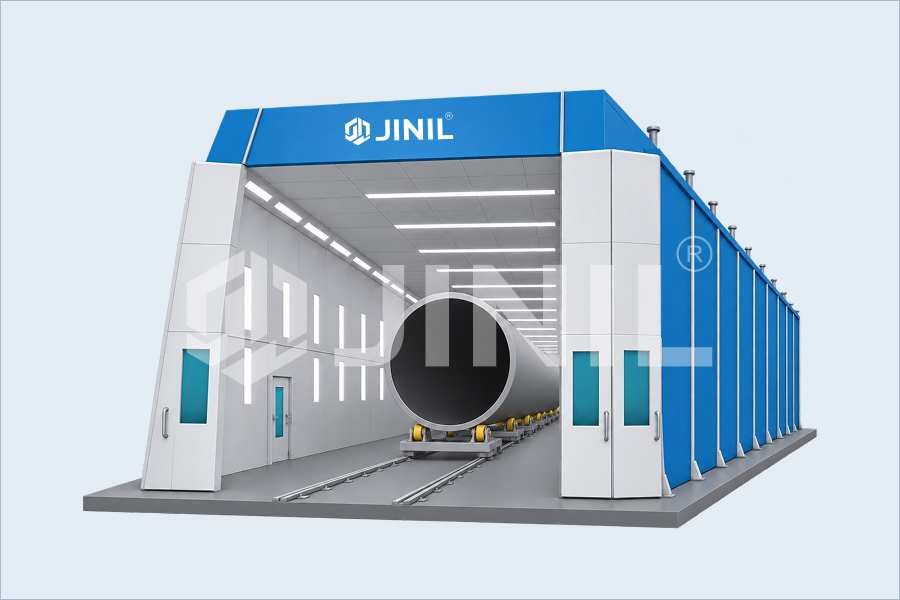
An industrial painting booth is a closed room where metal parts, fabrications, and machines get spray-painted. Fans bring in fresh air through filters. On the way out, the air passes through more filters or a water curtain, which catches the paint mist. So the wet paint stays free of dust, and the painter isn’t working inside a cloud of spray.
At Jinil, the first thing we ask is the size of the biggest part you paint. We also want to know which paint you use and how many parts go through in a shift. With that, our team works out the size of the painting booth, the airflow, and the filters. And once it’s installed, we’re still around for commissioning, filter changes, AMCs, and 24/7 support.
Smart Process Overview
Inside a Jinil paint spray booth, loading comes first. The blasted part comes in on a trolley or rail cart, or a crane lifts it in. In the fresh air in step, intake fans draw outside air through filters, so the air in the booth is clean.
As the painter sprays, the moving air carries the extra mist away from the part. This is spraying. For overspray capture, the mist is caught either in dry filters or in a curtain of water, depending on the booth.
Exhaust fans then push the cleaned air out through the stack. Last is unloading, when the painted part is taken out to dry or cure.
Jinil is a leading paint spray booth manufacturer in India, and we also make shot blasting machines. Since we build both, one team can plan your whole finishing line, from blasting through to painting. The booth, fans, filters, and controls are designed in our own factory, and our engineers work with you from the first layout until long after the booth is running.
You get blasting and painting from one supplier, so you deal with a single team for the full line. We plan the right size around your parts, paint, and floor space. Because of our in-house manufacturing, we design and build the booth in our own factory. For easy installation, our team plans the layout and ducting together with yours. Our after-sales care covers filters, spare parts, upgrades, and AMCs.
It begins with Requirement Analysis, where we look at your parts, your paint system, and your space. Then, in Booth Design, our team decides the booth type, airflow, and filters. The last stage is Installation and Commissioning, where we put the booth in, set it up, and test it.
A paint spray booth doesn’t have a fixed price. It depends on the size, the booth type, the airflow, and any extras, so we give you a quote based on your actual parts and plant.
Industrial Solutions
Our industrial paint booth systems are used to paint:
Fabricated steel structures: Beams, frames, and welded assemblies are primed and painted soon after they’re blasted.
Heavy machinery parts: For big frames and housings, we make the booth large enough for the painter to move around them.
Automotive components: Chassis parts, brackets and body panels need a smooth coat without dust marks.
Tanks and pressure vessels: Big curved surfaces need steady airflow, or the coat comes out patchy.
Railway parts: Bogies and wagon panels are repainted after an overhaul, or painted fresh on new builds.
Pipes and tubes: Coating them right after blasting stops rust from forming again.
Industrial Solutions
With a Jinil paint booth spray setup, your finishing line changes in a few ways:
Advanced Engineering Highlights
Here’s how a Jinil booth is built:
At Jinil, we make the booth types below. Our team will help you choose, depending on your parts, paint, and the space you have:
Cross Draft Booth: Air comes in at the front, moves across the part, and leaves at the back. It’s the simplest and lowest-cost option, and it’s fine for most general painting.
Downdraft Booth: Here the air enters from the ceiling and goes out through the floor, so the mist is pulled straight down. Choose this one when the finish has to be very clean.
Semi-Downdraft Booth: Air comes in through the ceiling at the front and leaves at the back wall. You get a cleaner finish than with cross draft, and there’s no need to dig a floor pit.
Side Draft Booth: The air enters from above and exits through the side walls. It works well for long parts, or where a floor pit isn’t possible.
Dry Filter Booth: Paint mist sticks to filters that you replace when they’re full. It’s easy to look after and suits low to medium painting work.
Water Curtain Booth: Water runs down the back wall in a thin sheet and catches the paint mist. Plants that paint a lot every day usually go for this.
On a production line, your painting booth has to match the speed of everything else, and a manufacturing paint booth is built for that. Since we also make shot blasting machines and conveyors, we can connect the booth to them. Blasted parts then roll straight in for painting, without being moved around the shop. Our team plans the booth size, airflow, and part handling based on how many parts you need to finish in a shift, so painting doesn’t hold up the rest of your line.
On automotive parts, even a few dust marks can mean redoing the job. At Jinil, we build booths for chassis parts, brackets, body panels, and other vehicle parts. Our team sets up the airflow, lights, and filters so painters can keep a steady pace through the shift. If you need a finer finish, we’ll usually suggest a downdraft or semi-downdraft booth.
India has plenty of spray booth suppliers, but not many can also supply the blasting machine that comes before the booth. Jinil can. When you compare paint booth suppliers, ask three things: will the booth fit in with your surface preparation, how easy is it to change the filters, and who will service it later? Our team takes care of all three, so you work with one company for the whole line.
Every so often, a buyer asks if we make a portable paint spray booth for site jobs. Our honest advice is that a fixed booth works better for regular production, because the air moves more evenly and you get a cleaner coat. If you’re not sure which way to go, our team will talk it through with you.
It’s a closed room used for spray painting. Clean air is pulled into the paint spray booth; the extra paint mist gets trapped in filters or water, and the air is sent outside once it’s clean. That keeps dust off the paint and the mist away from the painter.
A booth has a cabin, intake filters, exhaust fans with ducting, overspray filters or a water curtain, lights, and a control panel. At Jinil, we size each of these for your parts and paint.
Based on how the air moves, there are cross draft, downdraft, semi-downdraft, and side draft booths. To catch overspray, you can pick either a dry filter or a water curtain booth. At Jinil, we make all of these, and our team will tell you which combination suits you.
You’ll find them in fabrication shops, heavy machinery plants, automotive units, railway workshops, oil and gas sites, and steel plants. Any plant that paints metal parts after blasting can use a painting booth.
Painters get a cleaner finish and use less paint, and they’re not breathing in spray all day. The overspray stays in the booth too, so nearby machines and floors don’t end up coated in it.
Most plants use both names for the same thing: a closed space for spray painting. You might hear “paint booth” used for one that dries or bakes the paint as well. A “spray booth” is normally just for spraying.
Find out how long they’ve been doing this, whether they build the booth themselves, and what help they give after it’s installed. It’s also useful if the same company can supply your blasting machine, so everything works together. Jinil can do both.
Yes. Every Jinil booth is built around your parts, paint, and space. We plan the size, airflow, filters, and doors to fit the way your plant works.