
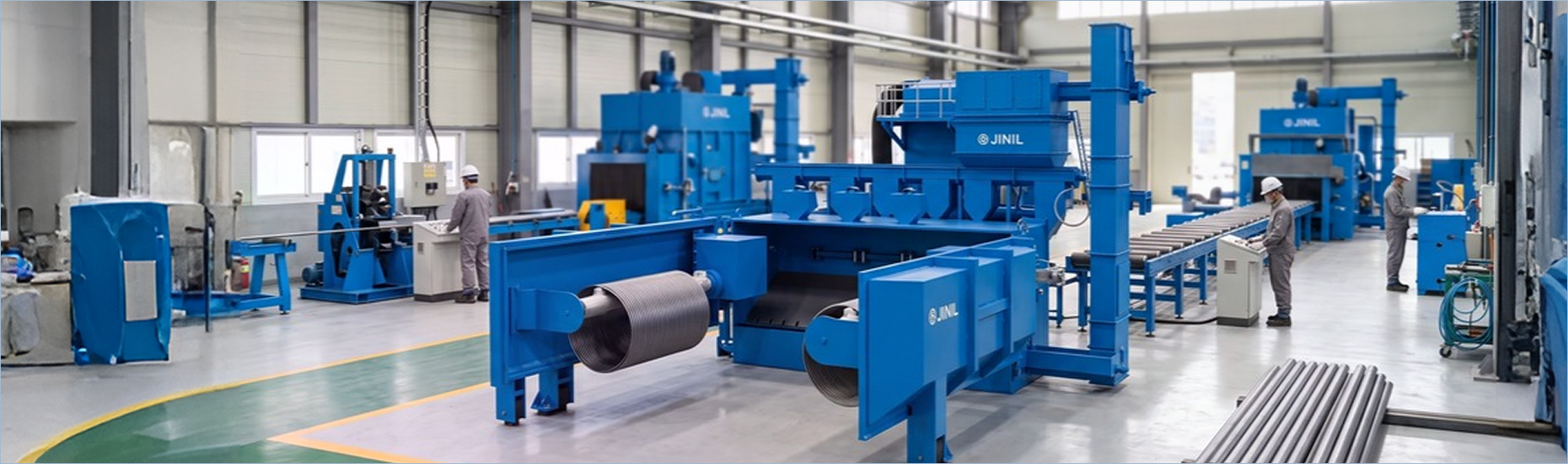
"Surface preparation is not the final step before finishing. It is the foundation that every downstream process is built on."
In wire and bar manufacturing, surface quality is not optional. As you can see, this can have significant implications for downstream operations such as drawing, coating, galvanising and cold forming. A shot blasting machine can remove rust, scale and surface oxides from wire and bar products with an efficiency and precision that chemical pickling can't compete with.
It doesn't matter whether you're dealing with a coiled product, a continuously fed product like a wire rod, or individual bars; the right machine ensures that the line keeps flowing and the surface quality is where you need it to be.
This blog covers everything you need to know about airless shot blasting machines built specifically for wire and bar processing, from how they work to how to choose the right one.
What Is a Shot Blasting Machine for Wire and Bars?
A shot blasting machine for wire coil is an industrial surface finishing system whereby centrifugal blast wheels eject or throw abrasive media (such as steel shot) at the surface of metal components. These abrasive particles clean mill scale, rust, oxide coatings, and any surface deposits.
Understanding what is a shot blasting machine in the context of wire and bar production is important because these machines are engineered differently from standard cabinet or tumble systems. They are designed to handle moving products, whether coiled, continuous, or individually fed, without interrupting line speed or compromising surface coverage.
The core working principle involves blast wheels mounted around the product path. As wire or bars pass through the blast zone, abrasive is thrown at high velocity from multiple angles, ensuring uniform surface treatment on all sides in a single pass.
Types of Shot Blasting Machines by Application
Not all wire and bar shot blasting machines are built the same. The right type depends on your product form, line speed, and production volume. Here is a breakdown of the three main categories.
1. Coil Shot Blasting Machine
A coil shot blasting machine or wire rod coil shot blasting machine is designed for wire that arrives in coil form. The wire is uncoiled, passed through the blast zone at a controlled speed, and recoiled on the other end. This type is widely used in fastener manufacturing, spring production, and wire drawing operations where scale-free wire is a critical requirement.
The machine is built around a pay-off reel, a straightener, the blast chamber with multiple turbines, an abrasive recovery and recirculation system, and a take-up reel. Line speeds are adjustable to match wire diameter and surface condition requirements. This is one of the most common formats offered by any wire coil shot blasting machine manufacturer serving the wire processing industry.
2. Continuous Wire Shot Blasting Machine
A continuous wire shot blasting machine handles wire that is fed directly from a coil or rod mill without stopping. The wire moves through the blast chamber at high speed while blast wheels treat the surface uniformly from all sides. These machines are built for high-volume production environments where stopping the line is not an option.
The key engineering challenge in continuous wire machines is maintaining consistent blast coverage at varying line speeds. Advanced machines allow real-time adjustment of turbine speed and abrasive flow to compensate for speed changes.
3. Single Bar Shot Blasting Machine
Single bar machines process bars one at a time or in small batches through a roller conveyor system. Bars are fed into the blast chamber, treated on all sides as they travel through, and exit on the other end ready for further processing. These machines handle round bars, flat bars, angles, channels and structural sections across a wide diameter and length range.
This format is particularly well suited for steel service centres, forging units and engineering component manufacturers.
Why Shot Blasting Is Used in Wire and Bar Processing
"When surface preparation is done right, everything that follows becomes easier, faster and more reliable."
The purpose of the shot blasting machine in wire and bar processing goes beyond simple cleaning. It is a critical step that determines the quality and performance of every downstream operation.
Mill scale left on wire or bar surfaces causes uneven coating adhesion, accelerated tool wear in drawing dies, and inconsistent surface finish in finished products. Chemical pickling can remove scale but introduces acid waste, requires neutralisation, and adds significant process time and cost. Shot blasting eliminates these problems.
An industrial shot blasting machine removes scale mechanically, leaving a surface with a defined roughness profile that improves coating adhesion, reduces drawing die wear, and prepares the surface for galvanising, painting, or further cold working. Understanding the airless shot blasting machine working principle helps explain how high-speed abrasive projection delivers consistent surface preparation. The process is dry, continuous, and easily integrated into an existing production line.
Benefits of Shot Blasting for Wire and Bar Products
Shot blasting delivers clear, measurable advantages over alternative surface preparation methods. Airless shot blasting machine technology is particularly significant in wire and bar processing because of the speed, consistency, and low operating cost it brings to high-volume production.
1. Consistent Surface Quality Across the Entire Length
One of the most important advantages of shot blasting is uniformity. Every section of the wire or bar receives the same abrasive impact, which means surface cleanliness and roughness profile are consistent from start to finish. This directly improves adhesion quality in coating and plating operations.
2. Higher Throughput Compared to Chemical Pickling
Shot blasting is a dry, continuous process. There are no acid baths to monitor, no rinse-offs, and no need to dry. The steel runs through the blast chamber at production line speed, so the surface preparation stage does not cause a bottleneck to your process.
3. Lower Operating Costs Over Time
The abrasive media used in shot blasting is recirculated and reused continuously. Compared to the ongoing cost of acid, neutralisers and effluent treatment in pickling, shot blasting is significantly more economical at scale.
4. Improved Downstream Process Performance
A properly shot blasted surface reduces die wear in wire drawing, improves coating adhesion in galvanising and painting, and ensures better performance in cold forming and forging applications. The surface profile created by shot blasting creates a mechanical anchor that chemical cleaning cannot replicate.
How to Choose the Right Shot Blasting Machine
Choosing the right machine comes down to matching the equipment to your product, your line, and your production targets. Understanding the benefits of using an airless shot blasting machine in manufacturing can also help you evaluate whether the equipment can deliver the required efficiency, consistency, and throughput for your operation. There is no single answer that works for every operation.
Identify Your Product Type and Form
Start with what you are processing. Coiled wire, continuous wire rod, and individual bars each require a different machine configuration. Getting this right at the start eliminates the risk of buying a machine that cannot handle your product form at production speed.
Define Your Required Line Speed
Line speed is one of the most critical specifications. A machine that cannot keep up with your drawing or rolling line becomes a production constraint. For continuous wire applications, speeds can range from 10 metres per minute to over 60 metres per minute depending on wire diameter and surface condition.
Consider Diameter and Cross-Section Range
Different machines are built for different product dimensions. A machine designed for 5 to 20 millimetre wire cannot necessarily handle 50 millimetre bars. Define your full diameter range, including future requirements, before specifying a machine.
Evaluate Turbine Count and Placement
More turbines mean better coverage and higher throughput capacity, but also higher energy consumption. The placement of turbines around the blast chamber determines how uniformly the product surface is treated. A well-engineered turbine arrangement eliminates shadowing and ensures every side of the wire or bar is reached in a single pass.
Coiled Wire vs Continuous Wire vs Single Bar: Comparison
Here is a direct comparison to help identify which machine type fits your operation.
| Parameter | Coiled Wire | Continuous Wire | Single Bar |
|---|---|---|---|
| Product Form | Wire in coil | Wire rod from mill | Individual bars |
| Line Integration | Semi-continuous | Fully continuous | Batch or continuous |
| Typical Line Speed | 15 to 45 m/min | 20 to 60 m/min | 1 to 6 m/min |
| Turbine Count | 2 to 4 | 4 to 8 | 2 to 6 |
| Diameter Range | 3 to 32 mm | 5 to 25 mm | 10 to 150 mm |
| Best For | Fasteners, springs, drawing | Rod mills, high volume | Steel service centres, forging |
Industries That Use Wire and Bar Shot Blasting Machines
Wire and bar shot blasting is not limited to a single sector. The need for clean, scale-free surfaces is common across several industries where metal quality directly affects product performance.
Fastener manufacturers use shot-blasted wire to reduce die wear and improve thread forming consistency. Spring producers depend on scale-free wire to maintain fatigue strength and surface integrity. Steel service centres process bar stock for engineering and automotive applications where surface cleanliness is a customer requirement.
Forging units prepare bar stock before hot and cold forging to prevent surface defects in finished components. Wire drawing operations use shot blasting to replace or supplement pickling in their pre-drawing preparation process.
Tips for Wire and Bar Shot Blasting Machines
A well-maintained machine delivers consistent performance and a longer working life. These are the areas that need regular attention in wire and bar shot blasting systems.
- Monitor Abrasive Media Condition and Mix: The abrasive mix in the system directly affects blast quality. A mix that is too fine loses cutting efficiency. A mix with too many broken particles causes uneven surface treatment. Regular sieve analysis of the working mix keeps performance consistent and prevents premature wear on blast wheels and liners.
- Inspect Blast Wheel Components at Regular Intervals: Blast wheels, impellers, control cages, and liners are wear parts. Their condition directly affects blast pattern, velocity, and energy efficiency. Inspection at fixed intervals and replacement before failure prevents unplanned downtime and maintains consistent surface quality.
- Check Conveyor Rollers and Guide Systems: In continuous wire and bar machines, conveyor rollers and guide systems take constant abrasive exposure. Worn rollers cause product misalignment, which leads to uneven blasting and surface defects. Regular inspection and timely replacement keep product feed stable and consistent.
What to Look for When Buying a Shot Blasting Machine
These issues should be addressed before the purchase decision.
Turbine design/coverage is a better consideration than the number of turbines. Ask for test results and blast simulations if appropriate, for your intended dimensions/product profile. Abrasive recovery and recirculation efficiency affect operating cost significantly over time. Machines with poor recovery systems consume more media and generate more waste.
Dust collection capacity must match the blast intensity of the system. Undersized dust collectors lead to poor visibility, contamination, and air quality issues inside the facility. After-sales support, spare parts availability, and service response time are as important as the machine specification itself. A machine that cannot be serviced quickly becomes a liability.
Our shot blasting machine for wire coil range is backed by engineering documentation, OEM spare parts, and a service team that responds when it matters.
Why Jinil Is the Right Choice for Wire and Bar Shot Blasting Machines
"Every wire and bar shot blasting machine we build goes through the same engineering validation process, whether it is a standard configuration or a fully customised system."
Jinil is a trusted wire coil shot blasting machine manufacturer with proven engineering capability across coiled wire, continuous wire, and single bar applications. Every machine is designed and built in-house, which means Jinil controls the engineering quality at every stage from design to commissioning.
The airless shot blasting machine range from Jinil covers the full spectrum of wire and bar processing requirements, with turbine configurations, line speeds and diameter ranges that match real production environments rather than theoretical specifications. Customisation is available for non-standard product dimensions, production speeds and integration requirements.
Jinil also provides installation, commissioning, operator training and after-sales support as part of every project.

Conclusion
Wire and bar shot blasting is just one of those processes which look simple from the outside but can influence a lot that happens down-the-line. The correct shot blasting machine removes scale quickly and protects all downstream tooling, and allows for superior coating quality and the continuation of your line at speed. Whether you are producing coiled wire, continuous rod, or even bars individually, the machine must suit your product, speed, and volume.
Jinil builds machines that do exactly that, with the engineering depth and after-sales commitment to back it up. If you are evaluating options, start with the product specification and work backwards from there.