
A painted, plated, or welded metal part is only as good as the substrate upon which it is based. If that substrate is still covered with mill scale, sand, rust, or even the remains of some past attempt at coating, the coating applied over it will not adhere, and it will be susceptible to corrosion a lot sooner. Which means surface preparation is neither optional nor does it come at the end of a process; rather, it’s the first point in deciding the life and performance of the entire part.
If your facility needs to handle a high rate of metal volumes, the airless shot blasting machine has become the most robust and reliable method of achieving the precise metal surface needed. It cleans, strengthens, and prepares the metal very rapidly and reliably in a consistent manner on every individual part.
What Is an Airless Shot Blasting Machine?
An airless shot blasting machine is an industrial machine designed to clean a metal surface. It consists of tiny particles, called shots or grits, blasted at metal. A powerful stream of metal shot or grit hits the surface, removing existing dirt or undesirable particles to leave a clean, uniform texture ready to be painted, coated, or galvanized.
The word "airless" explains how it is different from older systems. Traditional blasting uses compressed air to push the abrasive toward the part. An airless machine does not. Instead, it uses a fast-spinning wheel to fling the shot. This one change makes the process faster, far more energy efficient, and much better suited to continuous, high-volume work. That is why an airless shot blaster is the standard choice on busy production floors.
In short, an airless shot blasting machine does three tasks together. First, it cuts away unwanted material from the surface. Second, it creates a uniform surface profile. Lastly, it can strengthen the metal.
How Does an Airless Shot Blasting Machine Work?
The working principle is easy to visualize; a blast wheel, at the machine center, spins at high rpm and throws abrasive media at high speed by centrifugal force. Centrally loaded, the shot will fly outwards from the wheel due to centrifugal motion and is guided by the wheel's direction towards the object entering the blast chamber.
When the shot hits the surface, it displaces rust, scale, sand, and paint, while reforming the thin uppermost layer of the metal itself into a uniform surface.
When the shot hits the part, it drops down to the bottom of the machine where a retrieval system collects it, a separator system cleans it by blowing away the dust and broken-away pieces, and the usable shot is returned up to the wheel and is reused.
The entire time, a dust collector extracts fine dust particles from inside the cabinet, helping keep the air clean and the inside view clear. The cycle of throw, recover, clean, and reuse enables the machine to run for long shifts with minimal wastage - perfect for large-scale, high-speed operations.
Key Components and Their Functions
A reliable machine consists of some critical parts. Knowing each part’s function helps in judging the quality of the build and plan maintenance.
- Blast wheel: It spins rapidly and determines how fast and hard the shot impacts the surface. The design and condition of this unit ultimately determine the speed, coverage, and energy needed to complete cleaning.
- Blast chamber: This is where blasting occurs. A piece of flying shot destroys steel rapidly, so the chamber has thick wear-resistant liners to prolong the life of the body of the machine.
- Abrasive recovery system: Most commonly, it is a combination of a bucket elevator and a screw conveyor. It collects the shot from the floor of the machine and raises it back up for recycling, and this is why the abrasive costs are low.
- Separator: The separator eliminates dust, sand, and broken parts from the grit before the shot returns to the wheel. This is important as properly sorted and sized abrasive cuts much more cleanly than a mixture of dust and broken pieces.
- Dust collector: They suck out micro dust during blasting, which can make the working environment clean and safe, and ensure that the machines operate under environmental constraints.
- Material handling system: This moves the parts through the machine and depends on the specific machine, as they will look quite different.
Different Types of Airless Shot Blasting Machines
The correct selection depends on the shape, size, weight, and volume of what you are cleaning. Selecting the incorrect variety will result in elongated cleaning times, uneven cleaning, or damaged parts.
- Airless Shot Blasting Machine - Tumble Type: The parts are loaded into a rotating rubber-belt drum and then tumbled as they are hit by the wheel. As parts are tumbled, they rotate, thus ensuring that all surfaces have come in contact with the shot. It is best for small and sturdy components, e.g., fasteners, castings, and forged parts.
- Airless Shot Blasting Machine - Roller Conveyor Type: Here, the flat and long parts travel in a continuous line at the same pace in the cleaning chamber with the help of powered rollers. They are perfect for cleaning steel plates, beams, channels, etc.
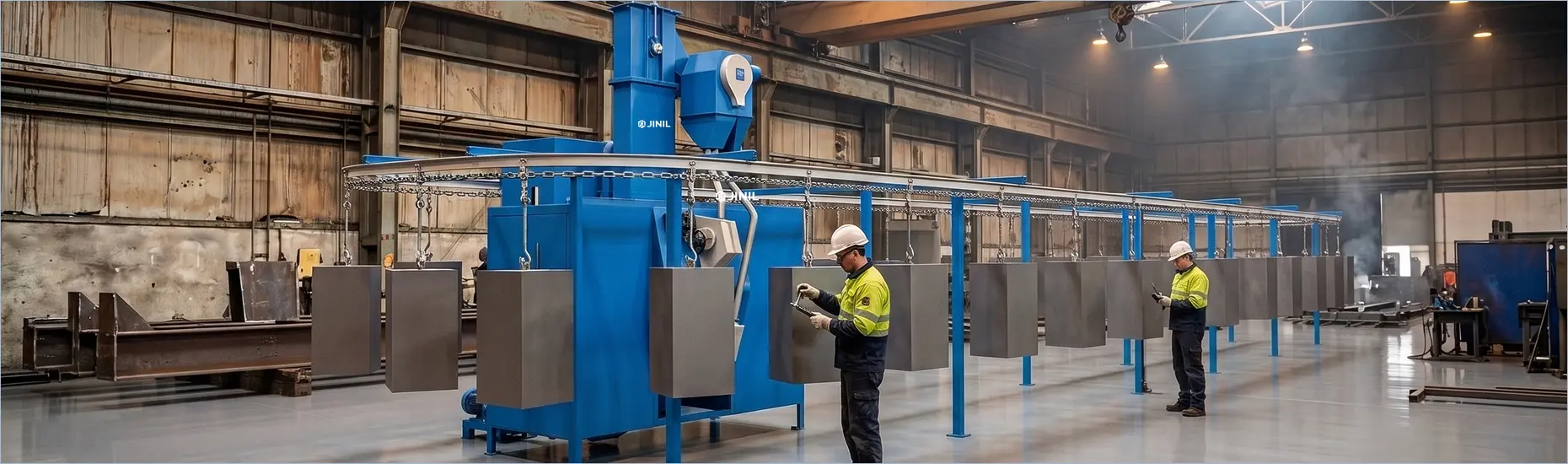
- Hanger Type Airless Shot Blasting Machine: Parts rotate through the blast stream to ensure they are cleaned on all surfaces. It works for delicate, heavy, or unusually shaped parts that cannot be tumbled in with other parts.
- Airless Shot Blasting Machine - Wire Coil: Designed to clean continuous strands of wire as they pass through the chamber. Applications are prevalent within the wire drawing and spring manufacturing industries.
- Airless Shot Blasting Machine Tunnel Type: A system where parts constantly move down a long blast tunnel on the conveyor. It is designed for steady, large-scale production and fits directly into an inline manufacturing flow.
The Airless Shot Blasting Machine - Tumble Type With Loader Arrangement option can further increase the production efficiency by allowing automatic loading, minimizing downtime between batches.
Airless Shot Blasting Machine Specifications
Once you have identified the type of machine your project requires, these technical specifications will reveal if a particular model will actually cope with the task.
| Specification | What It Tells You |
|---|---|
| Number of blast wheels | More wheels mean faster and more complete surface coverage |
| Blast wheel power (HP/kW) | Higher power throws shot harder and cleans tougher contaminants faster |
| Loading capacity | The maximum weight or volume the machine can process per cycle |
| Maximum part size | The largest component that fits inside the chamber |
| Abrasive throughput | How many shots the wheel throws per minute is a direct measure of cleaning power |
| Dust collector capacity | The air volume handled, which affects cleanliness, safety, and visibility |
| Cycle time | How long does it take to process one batch or part |
| Automation level | Whether the machine is manual, semi-automatic, or fully automatic |
Applications of Airless Shot Blasting Machines
The machine is well-used because it addresses a variety of surface issues at once through a single process.
Perhaps the most popular application is cleaning & descaling - taking off rust, mill scale, sand from new castings, as well as stripping old paint from parts that are to be repainted. A blasted surface has a minute texture that holds paint, primer, and powder-coat so that it holds up to years of use.
Another excellent and rewarding application is shot peening. In this operation, the shots are not fired to clean the surface but to strengthen the material. The continuous striking deforms the surface material, which helps in increased resistance to cracking and fatigue. This is of vital importance for highly stressed items like gears, springs, and shafts.
Industries That Benefit from Airless Shot Blasting
Almost any industry that works with metal in volume can put this technology to use.
- The automotive industry depends on it for engine parts, chassis components, and the shot peening of high-stress parts.
- Fabrication shops and structural steel workshops use it to prepare plates and beams before painting.
- Regular users include steel plants, oil and gas equipment makers, railways, pre-engineered building (PEB) manufacturers, and the wire coil industry.
- Sectors where surface integrity is non-negotiable, such as defense and aerospace, rely on it too.
In each case, the reason is the same: consistent, high-volume surface preparation that manual methods cannot match.
Airless Shot Blasting Machine vs Air Blast Machine
This is one of the most useful comparisons for a buyer to understand, because the two technologies are often confused.
| Feature | Airless Shot Blasting Machine | Air Blast Machine |
|---|---|---|
| Method | A spinning wheel throws the shot | Compressed air pushes the abrasive |
| Speed | High, ideal for volume work | Slower and more focused |
| Energy use | Lower and very efficient | Higher, due to air compressors |
| Best for | Large batches and continuous lines | Detailed, manual, or delicate work |
| Operation | Mostly automated | Often manual or semi-automatic |
Advantages of Airless Shot Blasting Technology
The reasons manufacturers move to airless blasting are practical and easy to measure.
- It’s faster because the wheel actually cleans more surface area than an air blast system would, and it keeps the production line moving.
- It’s more energy-efficient, since it’s a completely off-grid process that doesn’t require power-draining compressors to get the work done.
- It's repeatable and consistent; you will achieve the same desired results with every piece you produce.
- It's economical - you can reuse the abrasive loop again and again rather than continuously discarding them.
- And the units are inherently safer and cleaner- most systems are completely enclosed and automated, completely separating operators from the abrasive stream.
Cumulatively, these benefits add up to a strong and clear return on investment.
Factors Affecting Machine Performance and Productivity
Buying the right machine is only half the job. Several day-to-day factors decide how well it actually performs.
- Abrasive choice makes the most difference. The shot size, shape, and hardness must suit the material being cleaned and the desired finish, because selecting the wrong type can result in poor cleaning speed or damage to the surface.
- Wheel speed and angle affect the impact force of the shot and the surface it hits; both factors must be adjusted for the specific task.
- Wear parts such as liners and wheel blades should be checked; wear increases wasted energy and cuts speed.
- Correct part loading affects cleaning efficiency; too many parts prevent the shot from circulating freely in the machine and leave areas dirty.
Maintenance Tips for Long-Term Efficiency
A shot blasting machine works in a harsh, high-wear environment, so steady maintenance is what protects both your output and your investment.
- Regularly examine your blast wheel blades and replace them as soon as they begin to wear, as worn blades contribute to power waste and slow cleaning.
- Inspect the chamber liners as well as replace them after they begin to get thin, as it can expose the machine to damage.
- Clean the dust collection system regularly; if clogged, both your cleaning abilities and the air quality will be adversely impacted.
- Examine your shot recovery system, the screw conveyor, and the shot elevator for any blockages or wear.
- One of the simplest approaches to stay out of all of this is to do a day-to-day, regular monthly, or weekly checklist.
Future Trends in Shot Blasting Technology
As technology evolves, automation and robotics continue to become popular. Automation has enabled a reduction in manual handling and further increased uniformity, especially on more complicated surfaces. In the process of improving parts, sensors, and control system monitoring the performance of the wheels, abrasive flow, and component wear has made it possible to anticipate the failure of a part and the stoppage of the production line.
Wheels have also been engineered to consume less power, thus decreasing the operation cost.
In parallel, the ever-increasing regulatory demands regarding safety and the environment mean less particulate emission and a more convenient and safe working environment.
Why Manufacturers Choose Jinil Blast Shot
As an experienced Airless Shot Blasting machine manufacturer, Jinil Blast Shot builds systems around the real conditions rather than offering a fixed design. Each machine is engineered to suit your component geometry, batch weight, and automation needs, so the finish and the output match what your production actually requires.
This equipment is designed to be enduring with tough construction, heavy-duty liners, and highly efficient blast wheels for long, reliable operation. However, Jinil is equally concerned with servicing the equipment over its entire lifecycle, from setup and commissioning through to spares, planned service, and system upgrades in the future.

Conclusion
An airless shot blasting machine is one of the best ways to clean, prepare, and strengthen metal surfaces at scale. Once you know how the blast wheel drives the whole thing, which machine type suits your parts, and which specifications actually matter, buying becomes easy.
Match the machine to your real volume, get the abrasive right, and stay honest about maintenance, and it will remain steady in terms of quality and lower running costs for years. When the time comes to choose, go with a manufacturer who builds the solution around your needs, not one who hands you a standard model.