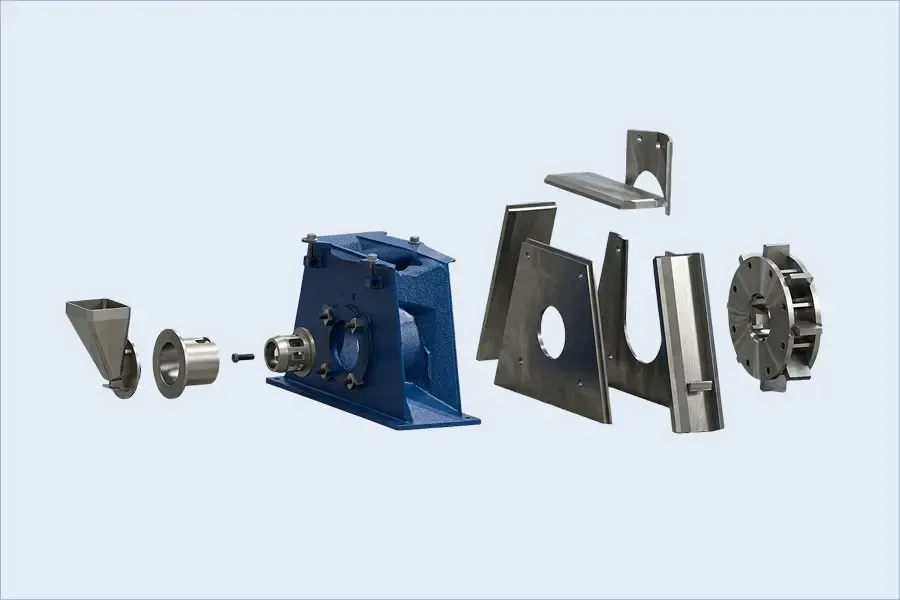
The blast wheel is the core component of every airless shot blasting machine. It converts electrical energy into kinetic energy and is used for accelerating the shot/grit to a high velocity and projecting it onto the workpiece, thus cleaning, peening, or roughening the surfaces.
This shot-blasting wheel turbine is designed for efficiency, sturdiness, and even blasting, resulting in the greatest amount of cleaning with the least amount of abrasive required. The right wheel, correctly positioned and matched to the abrasive, determines a machine's cleaning speed, coverage, and running cost.
We design and supply optimized blast wheel systems with precise positioning and abrasive selection to achieve maximum productivity and uniform surface finish.
Smart Process Overview
Abrasive enters the control cage through the feed spout, which sets the direction of the throw. From there, it passes to the impeller at the centre of the wheel.
The impeller gives the abrasive its first push and feeds it onto the rotating blades. The blades, or vanes, then accelerate the media to full velocity and release it in a controlled blast pattern.
That high-speed stream strikes the surface to clean off rust and scale, peen the metal for fatigue strength, or roughen it for coating. Blade angle and cage position together control where the pattern lands and how tight it is.

Optimized Wheel Variants
The motor is coupled straight to the rotor, so there is no transmission loss. Compact, efficient, and low on maintenance.
A pulley and V-belt system that allows flexible mounting and easy servicing.
An advanced blade shape that improves shot acceleration and cuts abrasive consumption.
Blades that can be flipped, extending blade life and reducing downtime.
Built With Precision Components
Impeller
Gives the abrasive its initial acceleration and feeds it evenly onto the blades.
Control Cage
Sets the throwing direction and controls where the blast pattern lands.
Blades (Vanes)
Accelerate the abrasive to its final high velocity for the actual blasting.
Rotor / Wheel Hub
Holds the blades in place and carries them at high rotation speed.
Distributor
Feeds abrasive into the wheel evenly for a steady, consistent flow.
Housing with Liners
Protects the outer casing and takes the wear from the media inside.
Engineered Output Parameters
| Parameter | Range |
|---|---|
| Motor Power | 3 HP to 50 HP |
| Wheel Diameter | 300 mm to 650 mm |
| RPM Range | 1500 – 3000 RPM |
| Shot Flow Rate | 30 – 1200 kg/min |
| Blade Tip Speed | 60 – 80 m/s |
| Abrasive Size | 0.2 – 2.0 mm |
| Efficiency | 70 – 85% |
| Motor HP | 3 HP | 5 HP | 7.5 HP | 10 HP | 15 HP | 20 HP | 30 HP | 40 HP | 50 HP |
|---|---|---|---|---|---|---|---|---|---|
| Shot Flow | 30 – 60 | 60 – 100 | 80 – 120 | 120 – 180 | 150 – 220 | 200 – 300 | 300 – 450 | 450 – 700 | 700 – 1000+ |
| Typical Application | Small cabinet | Light duty | Tumblast | General use | Hanger / Table | Tunnel | Heavy duty | Plate blasting | High production |
Custom Engineered Mechanism
The blast wheel works with a wide range of metallic and non-metallic media, chosen to suit the finish and the job. Steel shot from S110 to S780 handles cleaning and peening, steel grit from G25 to G80 gives aggressive surface roughening, garnet in fine to coarse grades allows controlled blasting, and cut wire shots suit precision finishing. This range lets the shot blasting turbine serve varied processes that need different blasting intensities and surface profiles.
Industrial Solutions
The blast wheel drives the main surface-treatment jobs on any airless machine.
Surface cleaning, rust and scale removal
Shot peening to improve fatigue life
Surface roughening for coating preparation
Deburring and finishing
Industrial Solutions
A well-built wheel shot blasting machine turbine is what makes an airless system efficient.
Advanced Engineering Highlights
Decision Making Factors
Choosing the right wheel comes down to a few key factors.
Additional System Enhancements
It is the core component of an airless machine that throws abrasive at high speed. It converts motor power into kinetic energy to clean, peen, or roughen a surface.
Feed passes into the control cage, impelled by the initial throw of the impeller, and then accelerated to high speed by the spinning blades as it is released in a controlled blast.
Direct drive, belt drive, high-efficiency curved blade, and double-sided reversible blade wheels, each suited to different efficiency and maintenance needs.
Ranging from 3 HP to 50 HP, offering a shot flow ranging from around 30 kg/min on small cabinets up to over 1000 kg/min on high-production machines
Steel shot (S110 to S780), steel grit (G25 to G80), garnet, and cut wire shots, for both metallic and non-metallic work.
Through the control cage and blade angle. Adjusting the cage tunes where the abrasive lands and how tight the pattern is.
Featuring durable alloy blades with double-sided reversibility and a speed-change mechanism to minimize downtime.
Match it to your required capacity, machine type, abrasive, component shape, and production rate. As a rule, 1 HP gives about 10 to 12 kg/min of shot flow.