
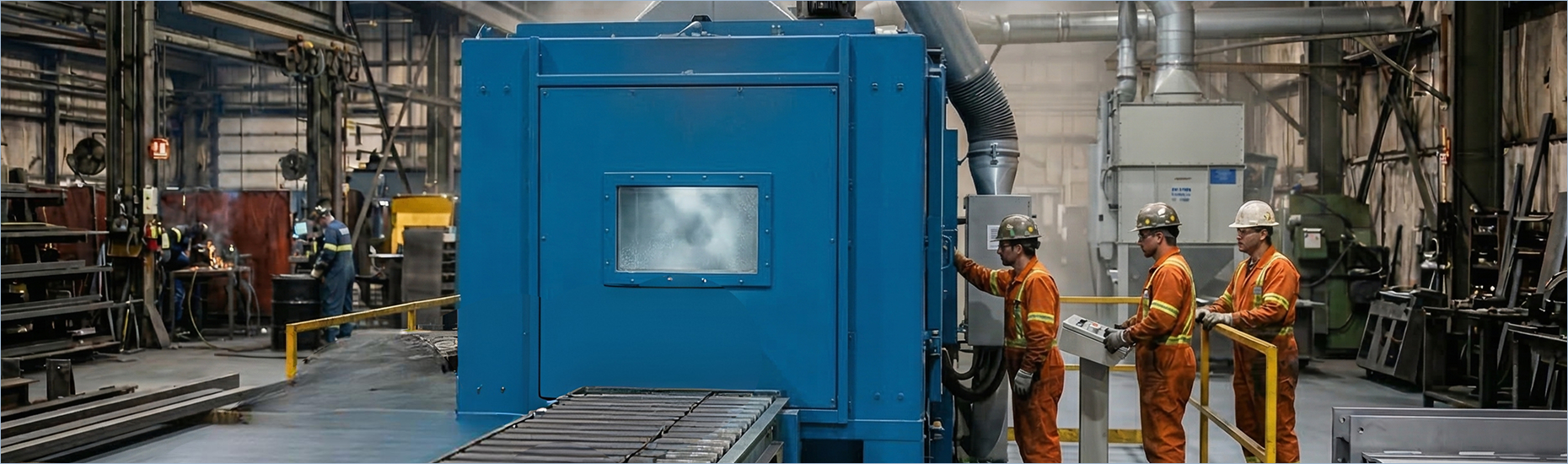
The manufacturing of modern products typically requires as much emphasis on preparing their surfaces before they are manufactured as it does on the actual manufacturing process itself; therefore, the surface preparation of an item will have a direct effect on how long the item will last in service, how well any coating will adhere to it, how well the item will resist rust or corrosion, and ultimately how good the finished product will look. One method of preparing these surfaces is through the use of shot blasting machines.
The shot blasting process uses an abrasive material (steel shot or steel grit) that is propelled at high speeds to clean or prepare an object using a mechanical process. This method will remove any rust, mill scale, oxidation, welding residue, or other contaminants from the surface of the item being prepared and provide a consistent surface to receive paint, coatings, or further processes.
Shotblasting technology is utilized by manufacturers in a variety of industries, including automotive manufacturing, foundries, steel fabrication, aerospace, rail, construction, and oil and gas industries. As production runs increase & quality standards are increasing, so are the needs of manufacturers to invest in shotblasting equipment capable of consistently & reliably preparing component surfaces for their final finish.
After defining what Shot Blasting/Shot Blast Systems are and how they work, defining types of Shot Blasting/Shot Blast Machines, as well as knowing every application available for each type of Shot Blasting/Shot Blast Machine, the manufacturer will know exactly which Shot Blasting/Shot Blast System is most suitable for the user's needs.
What Is a Shot Blasting Machine?
Shot Blast Machines are industrial processes that need abrasive media to clean, strengthen, and/or prepare a surface by using “high-speed” mechanical abrasion on an object. Therefore, unlike other surfaces, which may have been treated individually using manual methods only, components using shot blasting will be treated evenly across their entire surface as a result of utilizing mechanical forces to accomplish this.
Here are the three core elements:
- Blast Wheel or Air System – Quickly moves abrasive media toward the component surface.
- Abrasive Media – Materials such as steel shots, steel grit, or aluminum oxide are used to clear the surface.
- Recovery and Dust Collection Systems – Recycle reusable abrasive media and remove dust and contaminants.
Abrasive substances create a smooth finish while removing undesired materials such as rust, scale, or paint. This helps the surface be more receptive to receiving a coating, and also prepares the surface for further processing.
For facilities that have thousands of parts requiring an identical surface preparation process, shot blasting machines produce efficient, automated, repeatable results.
Why Surface Preparation Matters in Manufacturing
It is essential to understand why surface preparation is vital prior to considering the various types of machines available to conduct this essential task.
Surface preparation contributes significantly to poor surface adhesion and ultimately leads to coating/paint failures, shortened product life, and corrosion. Any contaminants growing (e.g., rust, oil, mill scale) that remain on a given surface will lead to failure of the coating or paint prior to its anticipated life expectancy.
Shot blasting provides manufacturers with the following advantages:
Increased adhesion of coatings
Increased corrosion resistance
Increased fatigue strength of metallic components
Uniform surface finishing
Elimination of scale, rust, and other contaminants
For those industries producing high-performance components, consistent surface preparation is not a choice - it must be done as part of an overall strategy to provide quality and reliability of production.
Types of Shot Blasting Machines
Different industries require different blasting solutions depending on component size, production volume, and manufacturing workflow. Below are some of the most commonly used types of shot blasting machines.
1. Tumble Type Shot Blasting Machine
Machines of the tumble type have been used extensively for cleaning small and medium-sized parts from batch manufacturing processes. A drum that rotates is loaded with parts, or parts are placed into a rubber-belt chamber; the parts then tumble or cascade continually through the process while being blasted with media.
Due to the tumbling action, the entire surface of each part is subject to abrasive forces in an aggregate manner, making tumbling in this way applicable for castings, forgings, and fasteners.
Applications
- Foundry components
- Automotive parts
- Small forged parts
- Heat-treated components
2. Hanger Type Shot Blasting Machine
Hanger-type machines are designed for medium to large components that cannot be tumbled due to their size or geometry.
Components are suspended on rotating hooks inside the blast chamber. This allows abrasive media to reach all surfaces while preventing part-to-part collision.
Applications
- Fabricated structures
- Automotive chassis
- Steel frames
- Large castings
Manufacturers checking reliable blasting systems often consider engineered solutions such as those developed by Jinil, in which machines are configured based on component geometry, production volume, and abrasive flow requirements to keep consistent blasting performance.
3. Table Type Shot Blasting Machine
Table-type machines use a rotating worktable to expose components to abrasive media while maintaining stable positioning.
These machines are particularly useful when components require precise surface treatment without movement or collision.
Applications
- Flat components
- Dies and molds
- Machine bases
- Structural plates
4. Tunnel Type Shot Blasting Machine
Continuous production lines use tunnel-type blasting systems. The components move through the blasting chamber via conveyors, and the blast wheels clean the surfaces of the components as they pass through.
These machines are well-suited for manufacturing operations that require a high volume of output.
Applications
- Steel plates
- Structural beams
- Pipes and profiles
- Automotive production lines
5. Portable Blasting Machines
On-site cleaning and maintenance operations have the ability to utilize portable blasting machines.
Portable blasting machines utilize compressed air to propel abrasive media, making them best suited for field applications such as cleaning bridges, storage tanks, pipelines, and shipyards.
Benefits of Shot Blasting Machines
Manufacturers invest in shot blasting systems because they provide many operational advantages.
1. Improved Surface Quality
Shot blasting removes rust, scale, and contaminants while producing a smooth surface texture suitable for coatings.
2. Increased Production Efficiency
Automated blasting systems can process large volumes of components quickly, reducing manual labor and improving productivity.
3. Better Coating Performance
Surface roughness created by blasting improves paint and coating adhesion, increasing product life.
4. Enhanced Metal Strength
Shot blasting can improve strength by reducing internal stresses in metal components.
5. Reduced Maintenance Costs
By stopping corrosion and coating failure, properly blasted components require less maintenance over time.
Industries That Rely on Shot Blasting
Shot blasting technology is widely used across many industries where metal surfaces require cleaning or preparation.
Automotive Industry
Used for cleaning engine components, chassis parts, and suspension components.
Foundries
Necessary for removing sand and scale from castings after molding.
Steel Fabrication
Prepares steel structures for painting or galvanizing.
Aerospace
Ensures precision surface finishing for critical components.
Oil and Gas
Used for pipelines, valves, and structural components in extreme environments.
Choosing the Right Shot Blasting Machine
Selecting the right machine depends on several factors.
Component Size
Small parts may require tumble machines, while large structures may need hanger systems.
Production Volume
Batch systems are for smaller production lines, while conveyor systems support continuous manufacturing.
Surface Finish Requirements
Different abrasive types and blast levels produce different surface profiles.
Automation Level
High-volume manufacturing often needs automated blasting solutions connected to production lines.
Working with experienced blasting system manufacturers, checks machines are configured for production conditions and not generic specifications.
The Future of Shot Blasting Technology
As manufacturing becomes more automated and data-driven, shot blasting machines are also changing.
Modern systems have:
- PLC-based automation
- Energy-efficient blast wheels
- Advanced dust collection systems
- Predictive maintenance monitoring
- Integration with Industry 4.0 manufacturing systems
These advancements help manufacturers reduce operating costs while maintaining surface quality.

Conclusion
Mechanical abrasive blasting (also known as shot blasting) is an important step in the modern manufacturing process. They are used to clean recently poured foundry castings and prepare structural steel for protective coatings. The use of a shot blast system ensures that all surfaces meet required levels before any final durability and performance tests, as well as completion of any final finishing processes.
When a manufacturer chooses an appropriate type of shot blasting machine that fits their individual requirements, this will improve the ability of the manufacturer to select suitable solutions for their production operation. Manufacturers who use the right blast equipment will experience great improvements in product quality, production efficiency, and product lifecycles produced with the equipment.