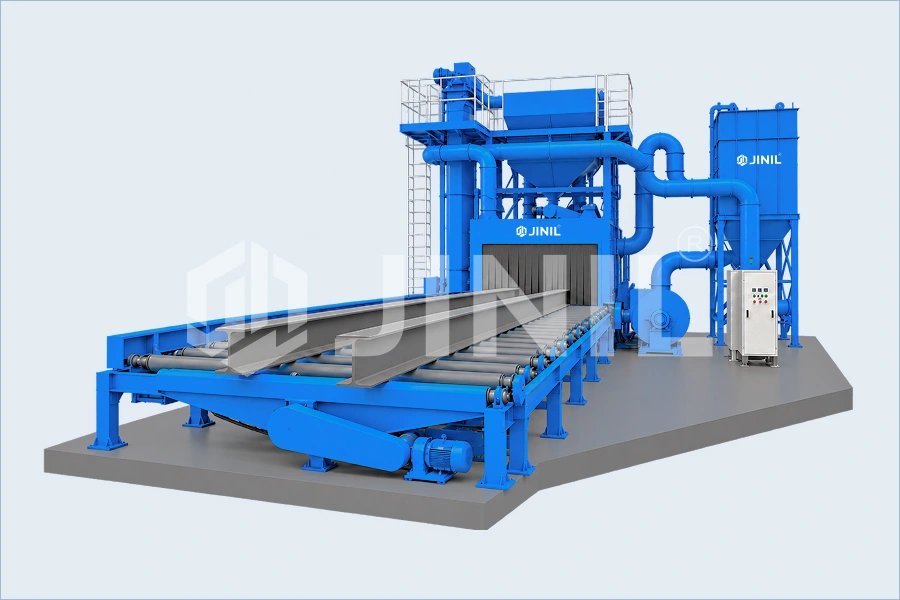
At Jinil, we make roller conveyor shot blasting lines for beams, columns, channels, angles, and plates. Think of it as a steel shot blasting machine for long sections. A beam goes in at one end and comes out clean at the other, with no grinder needed. Wheels placed around the section blast the top, bottom, and sides together, taking off rust, scale, and weld spatter on the way.
Every shop’s steel is a little different. One may handle mostly light angles and flats, while another sends heavy beams through all day. As a structural steel shot blasting machine supplier in India, we check your biggest section and how many tons you clean daily before planning the chamber, wheels, and conveyor. Once the machine is up and running, our service team is still around for commissioning, spare parts, AMCs, and 24/7 support.
Smart Process Overview
Steel sections go through a Jinil machine in a few simple stages. Loading comes first. The section is put on the infeed roller conveyor, usually with a crane for heavier beams. The conveyor then moves it slowly and evenly into the blast chamber, which is the entering-the-chamber step.
Inside, blasting begins. Blast wheels above, below, and on both sides throw steel shot or grit at the steel. The wheel layout is set so the blast reaches all faces in one pass.
Shot tends to sit on the top flange, so in shot removal, brushes and an air blow-off clear it before the steel comes out. For abrasive recovery and cleaning, used shot falls into a hopper, and a screw conveyor and bucket elevator lift it to the separator. There, dust and broken bits are taken out, and only good shot goes back to the wheels.
At the end comes unloading. Clean steel rolls off the outfeed conveyor, ready for primer or paint.
Built With Precision Components
Blast Chamber
This is where the blasting happens. It’s made of strong steel and lined on the inside.
Blast Wheels
They sit around the section and hit every face. For larger sections, more wheels may be added.
Roller Conveyor
Heavy-duty rollers carry the steel through at a fixed speed, even when the beams are long and heavy.
Abrasive Mix
Most lines run steel shot, steel grit, or a mix of both. Our engineers will help you pick the right steel shot for shot blasting machine use, based on the surface your coating needs.
Abrasive Recovery System
Used shot doesn’t go to waste. A hopper, screw conveyor, and bucket elevator bring it back up.
Separator
Before shot is reused, the separator strips out dust, fines, and broken pieces.
Shot Removal Unit
At the exit, brushes and air nozzles clear off any shot lying on the steel.
Dust Collector
Cartridge or bag filters keep pulling dust out of the chamber.
Wear Protection Liners
The inner walls take hits all day, so these liners protect them and can be swapped when worn.
Control Panel
One panel runs the wheels, conveyor, and dust collector.
Jinil is a leading structural steel shot blasting machine manufacturer in India. The main parts of the line are designed and built in our own factory, from the blast wheels and chamber to the roller conveyor, recovery, and dust collection. They are made to work together, and when you need help, you call our team directly, from the first layout drawing right through to after-sales service.
With in-house manufacturing, everything is designed and made in our own factory. We plan the right fit around your section sizes and daily tonnage. You get a complete line, since the machine, conveyors, and dust collection come from one supplier. For easy installation, we plan the layout together with your team. Our after-sales care covers spare parts, upgrades, and AMCs.
From Enquiry to Installation
It begins with Requirement Analysis, where we check your section sizes, tonnage, and floor space. Then, in Machine Configuration, we plan the wheels, conveyor, and automation. The last stage is Installation and Commissioning, where our team installs the machine, sets it up, and tests it.
There’s no fixed price for a structural steel shot blasting machine. The cost depends on the chamber size, number of blast wheels, conveyor length, and automation level, so we quote based on your actual steel and output.
Industrial Solutions
The steel our structural steel shot blasting machines usually handle:
I-beams, H-beams, and columns: Scale comes off from one end to the other, so the primer goes on evenly.
Channels, angles, and flats: Shot gets into the corners and along the edges too.
Steel plates and sheets: One pass cleans the top and bottom before cutting, welding, or painting.
PEB frames and purlins: These are long pieces, and the finish stays the same along the full length. That helps paint last outdoors.
Bridge and tower sections: Protective coatings on heavy steel need a clean base, and this gives them one.
Fabricated and welded structures: Spatter and slag around the welds are cleaned off before painting.
Industrial Solutions
Here’s what changes on your fabrication line with a Jinil steel shot blasting machine:
Advanced Engineering Highlights
This machine is made for long shifts and heavy steel:
Additional System Enhancements
Depending on your line, our team can add:
Hot sparks are stopped before they can reach the filters.
Small metal bits mixed in with the shot get pulled out.
It tells you when the shot is running low.
People working near the machine deal with less noise.
Steel moves straight from blasting into priming and painting.
It’s used to clean beams, channels, angles, and plates before they’re painted. Inside a structural steel shot blasting machine, steel shot is thrown hard at the surface. Rust and mill scale break away, and what’s left is a rough face that primer can hold on to.
A roller conveyor carries the steel through the chamber. Blast wheels placed around it clean the faces together, and the used shot is collected, cleaned, and sent back. Brushes and air at the exit clear off any leftover shot.
Beams, columns, channels, angles, flats, plates, and fabricated sections can all go through. We size the chamber opening to fit the largest section you handle.
Grinding a long beam by hand takes ages, and no two workers leave the same finish. The machine does it faster and the same way every time. Paint sticks better to the blasted surface, and fewer workers are needed for surface preparation.
PEB makers, steel fabricators, bridge and tower builders, steel plants, and heavy engineering units all use them. At Jinil, we supply surface treatment machines to plants in more than 25 industries.
Yes. The only limit is the chamber opening, so anything that fits through it can be blasted. Many plants run beams, channels, and plates on one machine. Our team sets the wheel positions so each shape gets cleaned properly.
Start with three things: the biggest section you run, the longest length, and your daily tonnage. Between them, they decide the chamber size and how many wheels you need. Share these with our engineers, and we’ll suggest a setup that fits.
Yes. We build every Jinil machine around your sections, output, and floor space. The wheel layout, conveyor length, and automation are all planned to match your plant.
Talk to our engineers about the right airless shot blasting machine, blast room, or dust collector for your production line.