
In industrial manufacturing, surface preparation is often underestimated, yet it plays a decisive role in product performance and longevity. Whether a component is cast, forged, fabricated, or machined, its surface condition directly affects coating adhesion, corrosion resistance, and structural reliability.
Metal components often develop mill scale, oxidation, rust, welding residues, and contaminants during production. If these are not properly removed, coatings fail prematurely, corrosion accelerates, and structural performance is compromised. This is why manufacturers rely on airless shot blasting machines, a highly efficient and production-oriented surface preparation solution.
Unlike air-operated shot blasting machines, which depend on compressed air, airless shot blasting uses centrifugal force generated by high-speed blast wheels. This allows faster processing, consistent surface finish, and better control over blasting intensity. It is widely considered the most reliable solution for industrial surface preparation in high-volume environments.
What Is an Airless Shot Blasting Machine?
An airless shot blasting machine is a mechanical system designed to clean, strengthen, or prepare surfaces by propelling abrasive media at high velocity using rotating blast wheels.
The process works on kinetic energy transfer, where abrasive particles strike the surface and:
- Remove rust, scale, and surface contaminants
- Create a uniform surface profile
- Improve coating adhesion and bonding strength
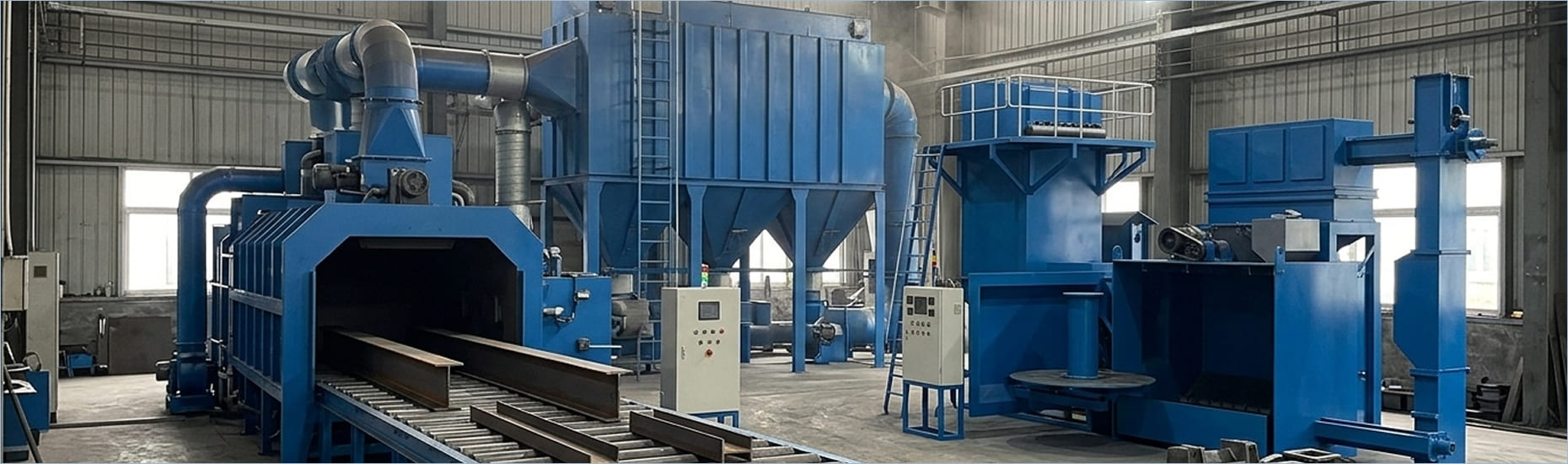
A typical system consists of blast wheels, abrasive handling units, recovery systems, and dust collectors, all working together in a closed loop. This makes airless shot blasting machines highly efficient, cost-effective, and suitable for continuous industrial use.
Why Airless Shot Blasting Is Preferred in Industry
The widespread use of airless shot blasting machines is driven by their operational advantages. They deliver significantly higher productivity compared to air-operated systems, primarily because blast wheels generate greater impact energy. This allows faster cleaning cycles without compromising surface quality.
Another key advantage is consistency. Since the process is mechanically controlled, it ensures uniform results across large batches of components. This is especially important in industries where even minor variations can affect performance and durability.
Manufacturers looking for reliable, production-oriented solutions often turn to engineered systems like those developed by Jinil, where machines are configured based on real operating conditions such as component size, throughput, and abrasive flow requirements to ensure consistent blasting performance.
Types of Airless Shot Blasting Machines
Different manufacturing processes require different configurations of airless shot blasting machines. Selecting the right type ensures optimal efficiency and surface quality.
Tumble Type Shot Blasting Machine
Tumble-type machines are designed for batch processing of small to medium-sized components. Parts are placed inside a rotating drum or belt system, where continuous tumbling ensures complete exposure to abrasive media. This makes them highly effective for cleaning multiple components simultaneously without manual repositioning.
Hanger Type Shot Blasting Machine
Hanger-type machines are ideal for medium to large components that cannot be tumbled due to their size or geometry. Components are suspended on rotating hooks, ensuring uniform exposure to abrasive media while preventing surface damage from collisions.
Table Type Shot Blasting Machine
Table-type machines are used for components that require stability during blasting. A rotating table ensures controlled, uniform exposure, making it suitable for precision applications where maintaining component geometry is critical.
Tunnel Type Shot Blasting Machine
Tunnel-type machines are designed for continuous production environments. Components move through a blasting chamber on conveyors, enabling uninterrupted processing and high productivity for large-scale manufacturing.
Roller Conveyor Shot Blasting Machine
Roller conveyor systems are used for large and flat components such as steel plates and fabricated structures. They ensure consistent surface cleaning across wide areas and are ideal for integration into production lines.
Applications of Airless Shot Blasting Machines
Airless shot blasting machines are used across industries where surface preparation directly impacts product performance.
In the automotive industry, they are used to clean engine parts, chassis, and suspension components to ensure durability and coating adhesion. In foundries, they remove sand and scale from castings, improving finish quality and dimensional accuracy.
Steel fabrication industries rely on these machines to prepare surfaces for painting, welding, and galvanizing. Similarly, sectors like railways, heavy engineering, and oil and gas use shot blasting to ensure long-term durability of components exposed to harsh environments.
Benefits of Airless Shot Blasting Machines
One of the key advantages of airless shot blasting machines is their ability to deliver high productivity while maintaining consistent surface quality. The use of high-speed blast wheels significantly reduces processing time compared to air-operated systems.
These machines also ensure a uniform surface finish, which minimizes rework and improves product quality. Since abrasive media is recycled within the system, operational costs are reduced, making the process more economical.
Another important benefit is improved coating adhesion. The controlled surface profile created during blasting allows paints and coatings to bond effectively, increasing corrosion resistance and extending component life.
Additionally, modern machines are equipped with advanced dust collection systems that improve workplace safety and reduce environmental impact.
How to Choose the Right Airless Shot Blasting Machine
Selecting the right airless shot blasting machine requires a clear understanding of your production process rather than simply choosing a machine type. The decision should begin with evaluating the size, shape, and weight of the components, as these factors determine how they should be handled during blasting.
Smaller components that can be processed in bulk are typically suited for tumble-type machines, while larger or delicate components require hanger-type systems to prevent damage. For operations involving continuous production, conveyor-based or tunnel systems offer better efficiency compared to batch processing machines.
Production volume is another important factor. High-volume environments require machines that can operate continuously with minimal downtime, whereas smaller operations may benefit from flexible batch systems.
Surface finish requirements also play a critical role. Different applications demand different levels of roughness, which depend on abrasive type, blast intensity, and machine configuration. Additionally, factors such as automation, energy efficiency, maintenance needs, and integration with existing production lines should be carefully considered to ensure long-term performance and cost efficiency.

Conclusion
Airless shot blasting machines have become an essential part of modern manufacturing, offering efficiency, consistency, and scalability. From batch processing to continuous production lines, these systems provide reliable surface preparation solutions across industries.
By understanding their types, applications, and benefits, manufacturers can select the right solution to improve product quality, optimize operations, and ensure long-term performance.
