
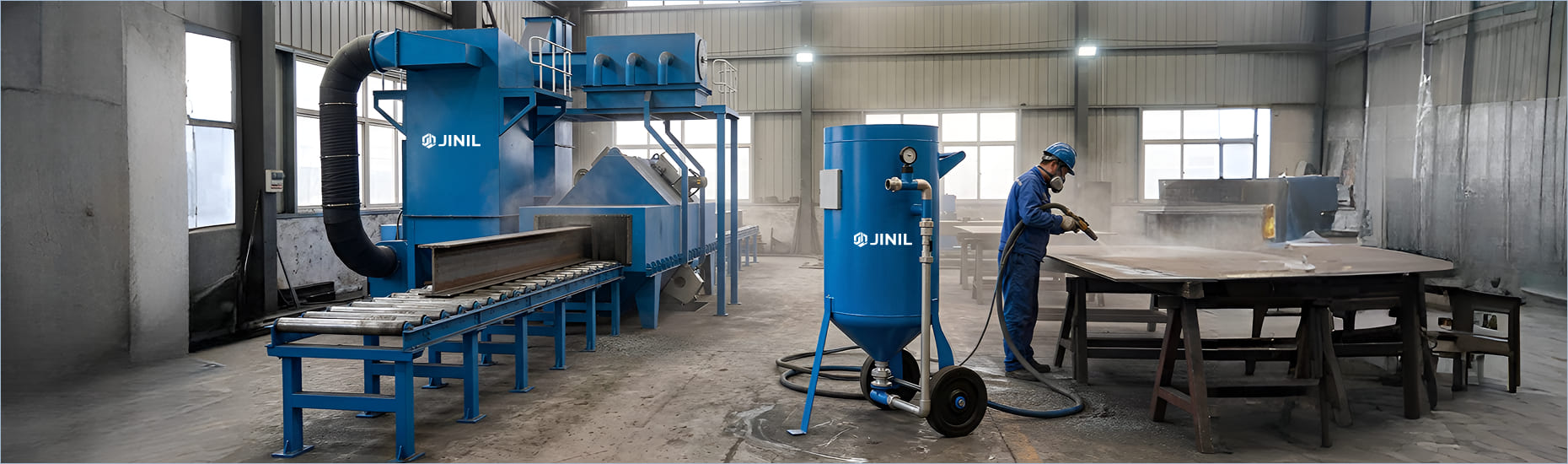
In industrial surface preparation, choosing the right blasting method can directly impact production efficiency, surface quality, and long-term operational costs. Among the most commonly used technologies are airless shot blasting machines and air-operated shot blasting machines.
While both serve the same fundamental purpose, removing rust, scale, coatings, and contaminants, their working principles, efficiency levels, and applications differ significantly. Understanding these differences is essential for manufacturers looking to optimize performance and reduce costs.
This guide breaks down how each system works, where they are used, and which one is better suited for your specific industrial requirements.
What Is Airless Shot Blasting?
Airless shot blasting is a mechanical process that uses high-speed rotating blast wheels to propel abrasive media onto a surface. Instead of compressed air, it relies on centrifugal force to generate impact energy.
The system typically includes blast wheels, abrasive recovery units, and dust collection systems, forming a closed-loop operation that ensures efficiency and consistency.
Because of its high-impact energy and automated nature, airless shot blasting machines are widely used in manufacturing environments where large volumes and uniform surface preparation are required.
What Is Air-Operated Shot Blasting?
Air-operated shot blasting, often referred to as sand blasting or grit blasting, uses compressed air to propel abrasive media through a nozzle onto the surface.
These systems are typically more flexible and are commonly used in applications where precision, portability, or localized blasting is required.
Air-operated systems can be found in:
- Portable blasting units
- Stationary blasting stations
- Automotive repair shops
While they may not match the speed of airless systems, they offer better control for detailed or small-scale operations.
Key Differences Between Airless and Air-Operated Shot Blasting
The difference between these two systems lies primarily in how abrasive media is delivered and how efficiently the process operates.
Working Principle
Airless shot blasting machines use centrifugal force generated by blast wheels, while air-operated shot blasting machines rely on compressed air. This fundamental difference affects speed, efficiency, and energy consumption.
Productivity
Airless systems are significantly faster and are designed for high-volume production. Air-operated systems are comparatively slower and better suited for smaller or specialized tasks.
Surface Finish Consistency
Airless blasting provides uniform and repeatable surface finishes, especially in automated setups. Air-operated blasting offers more control but may vary depending on operator skill.
Energy Consumption
Air-operated systems require continuous compressed air supply, which increases energy consumption. Airless systems are more energy-efficient in large-scale operations.
Application Flexibility
Air-operated blasting is more versatile and can be used for on-site work, intricate components, and localized cleaning. Airless systems are best for fixed, production-line environments.
Manufacturers often choose between these systems based on operational priorities such as speed, flexibility, and cost efficiency.
When to Use Airless Shot Blasting Machines
Airless shot blasting machines are ideal for industrial environments where productivity and consistency are critical.
They are best suited for:
- High-volume manufacturing
- Continuous production lines
- Large components or batch processing
- Applications requiring uniform surface finish
Industries such as automotive, steel fabrication, foundries, and heavy engineering rely heavily on airless systems for efficient surface preparation.
Manufacturers working with engineered systems like those developed by Jinil often benefit from machines that are configured specifically for their production requirements, ensuring optimal performance and long-term reliability.
When to Use Air-Operated Shot Blasting Machines
Air-operated shot blasting machines are preferred in situations where flexibility and precision are more important than speed.
They are commonly used for:
- On-site maintenance and repair work
- Cleaning complex or intricate components
- Small batch operations
- Surface finishing and deburring
Portable blasting systems and cabinet-type machines are widely used in workshops, maintenance environments, and industries where mobility is required.
Benefits of Airless Shot Blasting
One of the biggest advantages of airless shot blasting machines is their ability to deliver high productivity with consistent results. The use of blast wheels enables faster processing, making them ideal for large-scale operations.
They also reduce operational costs over time due to lower energy consumption and efficient abrasive recycling. Additionally, they provide uniform surface preparation, which improves coating adhesion and enhances product durability.
Benefits of Air-Operated Shot Blasting
Air-operated shot blasting machines offer flexibility and precision. They are highly effective for localized cleaning and detailed work where control is essential.
Their portability makes them suitable for field applications such as pipelines, tanks, and structural maintenance. They are also easier to use for smaller operations where full-scale automated systems are not required.
Which One Should You Choose?
Choosing between airless shot blasting and air-operated shot blasting depends on your specific operational needs rather than simply comparing features.
If your production involves large volumes, repetitive processes, and the need for consistent surface quality, airless shot blasting is the more efficient and cost-effective solution. It is designed for industrial environments where automation and throughput are key priorities.
On the other hand, if your work involves smaller components, complex geometries, or on-site applications, air-operated blasting provides the flexibility and control required. It is particularly useful in maintenance, repair, and precision finishing applications.
In many cases, manufacturers use both systems together, airless machines for production and air-operated systems for finishing or maintenance tasks.

Conclusion
Both airless shot blasting machines and air-operated shot blasting machines play important roles in industrial surface preparation. While airless systems offer speed, consistency, and efficiency, air-operated systems provide flexibility and precision.
Understanding the differences between these technologies allows manufacturers to choose the right solution based on their production requirements, ensuring better performance, lower costs, and improved product quality.
