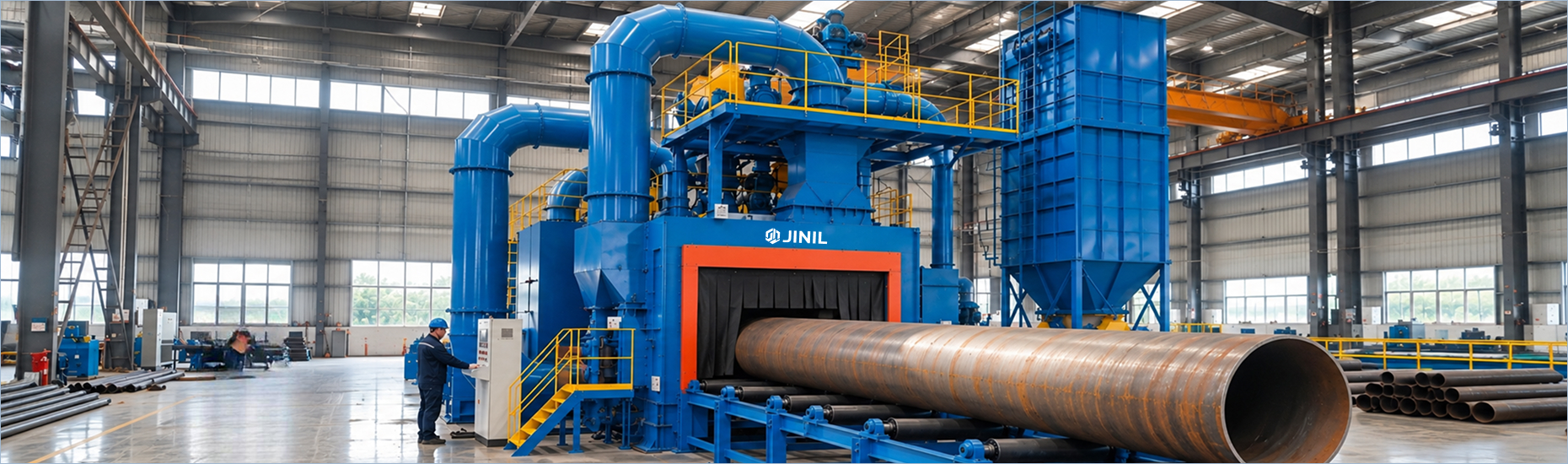
Whenever you ask a paint inspector why coatings tend to flake off pipes, they will tell you that the reason is never the paint itself. The reason is actually hidden under the paint surface. Rust, mill scale, or weld spatter left on the steel surface means there is nothing for the paint to stick to. That's the job of a pipe shot blasting machine. It throws abrasive at high speed onto the outer wall, the inner bore, or both, so the pipe comes out clean with an even surface profile.
In this blog, we will focus on how these machines function, the components and types, the type of abrasive to use, specifications, and the features to look for when buying one. At Jinil Shot Blast, we design and build these machines in-house and configure each one around the application.
What Is a Pipe Shot Blasting Machine?
A pipe shot blasting machine is simply a closed chamber where metal particles are blasted onto a pipe until all the rust, scale, old paint, and other contaminants are stripped off. The structure of the machine will depend on how the pipe will be rotated, moved, or kept stationary so that all parts of the surface will be blasted. This leads to a clean steel surface that can be painted and coated.
It is possible to manually clean and grind, but the results will vary among people. Automated shot blasting equipment removes that guesswork. This makes a real difference when a plant has to clean hundreds of pipes to the same standard.
You'll also see people search for a pipe sandblasting machine when they mean this process. The two aren't quite the same. Sandblasting uses compressed air and mineral media, whereas shot blasting uses spinning wheels and steel abrasive that goes back into the machine to be used again.
Where you'll find these machines:
- Oil, gas and water pipelines before FBE, 3LPE or epoxy coating
- Boiler, heat exchanger and pressure tubes
- Structural hollow sections for PEB and general fabrication
- Line pipe and casing in steel plants and stockyards
- Stored pipes that have picked up rust and need reconditioning
How a Pipe Shot Blasting Machine Works
The process is easy to picture. Abrasive strikes the pipe hard enough to knock off whatever doesn't belong there. The differences between machines come down to how the pipe is moved and how the abrasive gets to it.
- Loading: Pipes go onto a loading table or roller conveyor. The handling setup is chosen based on the pipe's diameter, length, and weight, and on how rusty it is.
- Rotation and movement: The rollers on the external equipment are inclined. The pipe rotates and moves forward simultaneously, and its full circumference goes through the blast in a spiral manner.
- Blasting process: The high-speed rotating blast wheels propel the abrasive onto the pipe. The energy of the blast wheel removes the rust and mill scale from the surface and creates the required rough surface for the coating.
- Recovery of abrasives: The abrasive is loaded into the hopper placed below the blasting chamber. The abrasive is lifted up through the screw conveyors and bucket elevators, where the usable abrasives are fed back into the blast wheel.
- Dust extraction: The dust-filled air is extracted and filtered from the machine. The small size of the collector affects both visibility and air quality negatively; that is why these dust collectors for shot blasting may be interesting for you.
- Unloading: Air jets or brushes clear off loose shot. The pipe then rolls out for inspection or heads straight to the coating line.
Cleaning the inside of a pipe needs a different approach. A steel pipe shot blasting machine designed for internal work usually handles smaller bores with an air-blast lance. Bigger pipes get a compact blast wheel mounted on a long arm. Either way, the tool works its way along the full length of the pipe.
Key Components of a Pipe Shot Blasting Machine
The table below shows what each part does and where it wears out first.
| Component | Role in the Process | What to Watch |
|---|---|---|
| Blast wheels | Throw abrasive onto the pipe; their number, power, and position decide coverage | Wear on blades, impellers, and control cages |
| Blasting chamber and liners | Hold the abrasive in; replaceable manganese liners take the repeated impact | Thinning liners in high-impact zones |
| Pipe handling system | Skew rollers, conveyors, or supports that turn and move the pipe | Roller alignment and bearing condition |
| Sealing curtains | Rubber flaps at the entry and exit that stop abrasive escaping | Tears or gaps that let shot leak out |
| Recovery and separator | Collects used abrasive, cleans it, and sends it back into circulation | Separator settings and debris build-up |
| Dust collector | Filters chamber air before it is released | Filter condition and pulse cleaning |
| Control panel | PLC or relay control of wheel load, conveyor speed, and interlocks | Amperage readings and interlock function |
Types of Pipe Shot Blasting Machines
Which machine suits you depends on the pipe's shape and size, your production volume, and which surface needs cleaning.
- External Pipe Shot Blasting Machine
- Internal Pipe Blasting Machine
- Conveyor-Type Continuous System
- Air-Operated Pipe Blasting
- Custom Pipe Blasting System
This is the most common setup. Long pipes ride through the chamber on skew rollers and turn as they go, so the outside gets cleaned all the way around. It works for everything from small tubes to large line pipe.
An internal pipe blasting machine is built to clean the bore. An air-blast lance usually does the job for narrow pipes, while an internal wheel head is more practical for wider ones. You’ll need one if the pipe is getting an internal lining or has scale inside that must come off. As the internal blasting machine is a separate purchase, verify if your specification actually requires internal preparation before purchasing it.
Plants that handle large volumes tend to go for a continuous pipe blasting machine in which pipes are fed sequentially. Some of these lines clean both the outside and the inside, with a transfer station in between.
A pipe sandblasting machine with nozzles comes out to be the most appropriate tool to be used for small fittings, cut-offs, repair purposes, and bores.
Extra-long pipes, heavy wall sections, and odd diameters rarely fit a standard model. For these jobs, the handling, blast coverage, abrasive recovery, and link to the next process are all designed around the actual work. Other round products are handled in much the same way, as you can see in this piece on shot blasting machines for coiled wire. Jinil configures custom systems around your pipe size, weight, and output, instead of fitting you into a fixed mode
Abrasives Used in Pipe Shot Blasting (Steel Shot, Grit, Cut Wire)
| Abrasive | Shape | Surface Result | Best For | Watch Out For |
|---|---|---|---|---|
| Steel shot | Rounded | Smooth, lightly peened finish | General rust and scale removal, paint prep | May not create enough profile for heavy-duty coatings |
| Steel grit | Angular | Sharper, deeper anchor profile | FBE, 3LPE and other specs that need strong adhesion | Wears machine parts faster |
| Cut wire (conditioned) | Cylindrical with rounded edges | Uniform finish with little dust | High-volume lines that need long media life | Costs more to buy upfront |
In practice, many coating plants don't stick to just one. They run a mix of shot and grit, letting the shot do the fast cleaning while the grit keeps the profile where it needs to be.
Shape isn't the only factor, either. Particle size, hardness, the condition of the media, and the machine's design all change the result. For pipeline work, specs often ask for Sa 2½ cleanliness (ISO 8501-1) and a profile of roughly 50 to 100 microns. Even so, the coating maker's datasheet should always have the final say.
Benefits of Pipe Shot Blasting Machines
- Consistent finish: Rotation and travel speed are controlled, so the first metre of a pipe matches the last. That's very hard to achieve by hand.
- Better coating adhesion: The paint and lining stick to the steel much better when it is clean and profiled, and they tend to last longer when the pipe is actually being used.
- More pipes per shift: The conveyor line will move the pipes continuously if the conveyor line has the right dimensions.
- Less manual work: Operators will not have to grind or scrap the pipes, but will load them and oversee the operation.
- Lower media spend: The abrasive media is recovered, but that depends on the system and your processes.
- Fits into the production line: Modern shot blasting equipment can be linked directly to preheating, coating, and curing stages.
- Cleaner shop floor: Blasting happens inside an enclosure, and the dust is extracted, so operators aren't breathing in grit.
Pipe Shot Blasting Machine Specifications Table (Pipe Diameter, Length, Wheels, Power, Capacity)
| Parameter | Small-Bore Lines | Mid-Range Lines | Large-Diameter Lines | What to Confirm |
|---|---|---|---|---|
| Pipe diameter | 50 to 300 mm | 150 to 720 mm | 300 to 1,600 mm and above | Minimum and maximum OD or ID |
| Pipe length | 2 to 12 m | 3 to 12 m | 6 to 14 m | Loading and unloading space |
| Blast wheels | 1 to 2 | 2 to 4 | 4 to 8 | Wheel position and throw direction |
| Power per wheel | 7.5 to 11 kW | 11 to 15 kW | 15 to 22 kW | Extra load for conveyors, recovery and dust extraction |
| Travel speed (capacity) | 2 to 6 m/min | 1.5 to 4 m/min | 0.8 to 2 m/min | Exposure time needed for the target finish |
Treat these figures as a starting point, not a quote. Several factors can push the design one way or another:
- pipe weight and wall thickness
- how rusty the pipes are when they arrive
- the cleanliness you're aiming for
Internal blasting also runs slower than external blasting. The size of the steel pipe shot blasting machine should be based on actual production figures and not motor power. When requesting a quotation, provide:
- pipe drawings or sample sizes
- the heaviest pipe weight
- the finish you need
- your expected output per shift
How to Choose the Right Pipe Shot Blasting Machine
- Pin down pipe sizes. Be aware of the minimum and maximum diameter, lengths, and weight of your pipe. Allow some leeway for future orders.
- Decide which surface matters. External machines won't touch the bore. If lining is part of the plan, you'll need an internal pipe blasting machine or a combined line.
- Agree on the finish. Decide whether the goal is rust removal, scale removal, or coating prep. Then write down the cleanliness grade and profile your project standard asks for.
- Work out throughput. Estimate how many pipes you need per shift and how many hours the machine will actually run.
- Look closely at abrasive and dust handling. The recovery system, separator, and collector have a big say in running costs over the years.
- Check the site. Floor space, foundation, power supply, and the hand-off to the coating line all need to line up.
- Ask about support. Find out who handles installation, commissioning, wear parts, operator training, and breakdowns.
One mistake comes up again and again: buying a pipe shot blasting machine that only covers today's order mix. When the product range grows, that machine becomes the bottleneck. A good pipe blasting machine is matched to your production data, not to how many wheels it has.
Maintenance and Wear Parts Tips
Daily
- Check the abrasive level and wheel motor amperage. A decrease normally indicates a problem with the flow of abrasive.
- Check for shot blowing past the curtains.
Weekly
- Check the blades, impellers, and control cages. Blades should be changed in sets so that the wheel does not vibrate.
- Check the rollers, bearings, and drives so that the pipe rotates evenly.
Monthly
- Check the chamber liners and seals, and replace damaged parts before the damage affects the structure.
- Check the dust collector filters, hoppers, and discharge points.
Ongoing
- Keep a log of inspections, replaced parts, breakdowns and abrasive top-ups, so recurring problems are easier to spot.
If there's one part to watch closely, it's the separator, because dirty abrasive wears out blades and liners much faster than clean media does. On an internal blasting machine, the lance nozzles and internal wheel parts take extra punishment from rebound in a tight space, so check them more often. These intervals are only a rough guide, and the manufacturer's own schedule should come first.
Safety and Environmental Considerations
The blasting line is a combination of moving machines, high-speed abrasives, dust, and noise. It is important to ensure safety depending on the design and maintenance of the machine, and the procedures followed by the team.
Do:
- Keep access doors closed and interlocks active while the machine runs.
- Lock out and isolate all energy sources before any servicing.
- Maintain the dust collector and dispose of collected waste in line with pollution control rules.
- Wear PPE, including hearing protection, as the site risk assessment requires.
- Secure pipes properly and make sure the handling system can take their weight.
- Keep reusable abrasive separate from contaminated waste.
Don't:
- Bypass safety devices to save time.
- Run the machine with torn curtains or worn-through liners.
- Let the filters clog until extraction drops off.
There's an environmental upside too. Steel abrasive doesn't carry the free silica risk linked to sand, and because it's recycled, far less waste leaves the plant.
Key Benefits of Jinil Pipe Shot Blasting Machines
Jinil Shot Blast designs and builds its machines in-house. Instead of selling a fixed catalogue model, the team configures each system around the component being cleaned and the way the plant runs. As a pipe shot blasting machine manufacturer, Jinil offers:
- Configuration based on application: The systems are configured based on pipe diameter, batch weight, production capacity, degree of automation, and plant configuration.
- Designed for continuous operation: The system is robust and abrasion-resistant, with efficient blast wheels.
- External, internal, and customised configurations: The systems have pipe, structural steel, and hanger configurations.
- Surface preparation line: The system includes an abrasives recovery system, dust collectors, and paint spray booths.
- Life cycle services: Installation, commissioning, maintenance contract, spares, and upgrade services are offered.
- Experience across industries: Jinil provides its services in the oil & gas industry, steel plants, PEB, railway, and heavy fabrication industries.
Buying all your shot blasting equipment from one supplier also makes service and spares much simpler. To talk through your pipe sizes, finish requirements, and production targets, get in touch with the Jinil team.

Conclusion
The steel is clean and therefore forms the surface upon which the coating is applied, and the pipe shot blasting machine is the best way to go about this. While choosing such a machine, you should pay attention to the size of your pipes, whether you require inner or outer surface cleaning, abrasive types, production rate of manufacture, and service. It is always better to discuss all these things with a good manufacturer. Jinil Shot Blast can help you match a pipe shot blasting machine to your pipe sizes, finish, and output.