A steel plate covered in mill scale needs different cleaning from a batch of small castings. A long pipe has its own requirements, too. However, before the processing of these materials in terms of painting or coating, there is a need to prepare their surfaces.
Shot blasting machines remove rust, scale, foundry sand, and other unwanted material by hitting the surface with abrasive media. But no single machine suits every job. Some are built for small parts, and others for heavy castings, bars, or pipes. That is why there are different shot blasting machine types.
What Is a Shot Blasting Machine?
This metal is cleaned with the aid of a shot blasting machine that shoots abrasive media at its surface. These abrasives are usually made up of steel shot and steel grit to get rid of rust, mill scale, foundry sand, and many others.
An airless shot blasting machine uses a special blast wheel that is especially effective for cleaning applications that repeat over time. An air-operated shot blasting machine uses a nozzle to beam abrasive material into any small area and shape.
A full setup of a shot blasting equipment may also include a loader and conveyor, as well as a dust collector and control panel. Your choice ultimately depends on the type of metal product and its condition.
How a Shot Blasting Machine Works
The details vary from machine to machine, but the base procedures are uncomplicated.
The workpiece goes in first. Small parts may be fed into a rotating disc or onto a belt, while larger ones hang from hooks or are mounted onto powered rollers.
Then the workpiece is blasted with the help of a blast wheel or a compressed-air nozzle. The impact knocks off the unwanted material, making the metal ready for the next stage.
Where recovery systems are incorporated into the design, the disposable abrasives are gathered, used or broken particles and dust are separated, and the good abrasives are put back into the system.
Once the blasting process has been completed, the finished product is taken out and examined for conformity with the specified finish. The final steps involve applying paint or varnish and further processing.
Many industries now use an automatic shot blasting machine to keep workers away from the blasting area.
Types of Shot Blasting Machines
The main reason for shot blasting machine types is that they vary in the way they hold and move the part being blasted. The solution to be chosen is defined by the part size, weight, form, and quantity.
Tumblast Shot Blasting Machine
A tumblast shot blasting machine cleans small and medium-sized components in batches. They are tumbled in a rotating drum or in a travelling belt with the abrasive reaching the surface of these parts.
This type of machine is widely used for castings, forgings, fastenings, gears, and other such parts. The company Jinil provides different types of tumbling machines with various load handling devices.
Tumblast machines are suitable for parts that can safely tumble together. Fragile components or parts that may become tangled or damaged through contact may need another type of machine.
Explore Jinil's tumble-type shot blasting machine with loader arrangement for more details.
Hanger Type Shot Blasting Machine
Some components are too large, heavy, or delicate to tumble. A hanger-type shot blasting machine holds them on hooks during blasting, reducing the risk of damage caused by parts knocking against each other.
These machines are commonly used for heavy castings, forgings, automotive components, and fabricated parts.
Jinil offers closed-loop conveyor systems that carry components along an overhead track. Hook capacities range from 250 kg to 5 MT, depending on the model. Double-door, monorail, and Y-conveyor arrangements are also available for different handling requirements.
See Jinil's hanger-type shot blasting machine with closed-loop conveyor.
Roller Conveyor Shot Blasting Machine
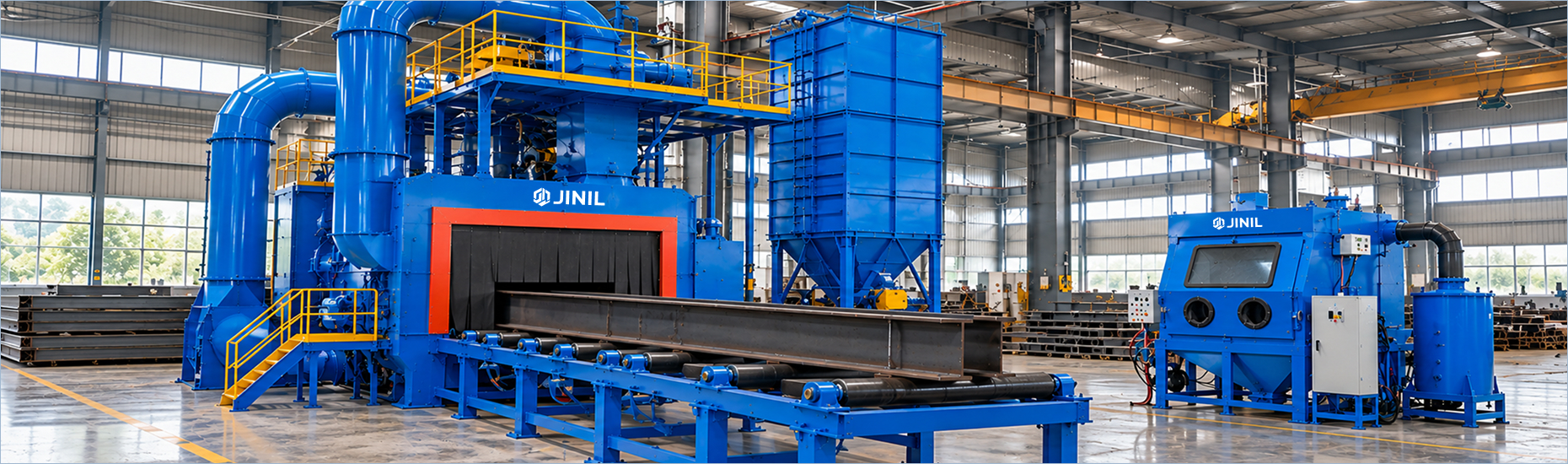
Plates, beams, channels, and angles need a machine that can handle their length. A roller conveyor shot blasting machine moves these steel sections through the blasting chamber on powered rollers.
The conveyor speed may also be matched with the arrangement of the wheels and the finish desired.
Roller conveyor machines are often used before primer or paint, so the steel goes from cleaning to coating without a break.
Read more about Jinil's roller conveyor type shot blasting machine.
Table Type Shot Blasting Machine
The table-type shot blasting machine might be used for blasting workpieces that are too heavy to be processed in a tumblast machine but can still be placed on a table.
Common uses of the technology involve large castings, gearbox housings, and mechanical components.
For workpieces that have a complicated configuration, adjustments in blast wheel position and speed need to be calculated so that proper coverage of the workpiece surface is achieved.
Pipe Shot Blasting Machine
The pipe shot blasting machine enables pipes to move and rotate in the course of blasting, making the abrasive get to the surface of the pipes.
Jinil offers roller and diabolo conveyors for pipes and other round workpieces. The right arrangement depends on the pipe’s diameter, length, and weight, as well as how many pipes are processed per shift.
Such machines are effective in industries such as oil and gas where pipes need to be treated before they are coated.
Structural Steel Shot Blasting Machine
Beams, channels, angles, and welded frames need cleaning before painting or coating. The structural steel shot blasting machine allows for the passage of these constructions through the blast chamber where the abrasive can reach the surfaces of the parts.
Roller-type and tunnel-type systems are the main types of systems. The choice depends on size, surface needs, and production volume. An automatic shot blasting machine can cut down manual work in busy fabrication shops.
Wire Coil Shot Blasting Machine
Wire can develop rust and scale before further processing. A wire coil shot blasting machine involves passing the wire through the area of blasting in order to remove the undesired particles.
It should be able to move the wire continuously without causing any delay to the production process.
Wire size, surface condition, and the next manufacturing stage all help determine the suitable setup.
Airless Shot Blasting Machine
An airless shot blasting machine that does not use air employs the principle of using the rotation of the blast wheel to drive the blasting process.
Tumblast, hanger, table, and roller conveyor machines can all use the airless blasting principle. The difference lies in how the workpiece is held and moved.
Explore Jinil's range of airless shot blasting machines to learn more about the available configurations.
Air-Operated Shot Blasting Machine
The air-operated shot blasting machine uses compressed air to propel abrasives via a nozzle. Such equipment is appropriate for situations where the abrasive should be directed towards particular areas, or when the workpiece cannot be placed on a wheel-blast system.
There are several types of blasting machines from Jinil, including portable blasters, suction/pressure blast cabinets, conveyor belt cabinets, and multi-gun blasters.
Applications of Shot Blasting Machines by Industry
Different industries use shot blasting to prepare components for the next stage of production.
- Foundries: Tumblast machines clean smaller castings, while hanger-type machines handle larger components with foundry sand and scale on their surfaces.
- Automotive manufacturing: Castings and forgings are cleaned before any further processing. Shot peening is sometimes applied in addition to cleaning for those parts whose fatigue performance has to be improved.
- Forging units: Tumblast and hanger-type machines clean forged products in accordance with their size and weight.
- Steel fabrication: Roller conveyor machines clean steel plates, beams, channels, and angles before painting/coating.
- Oil and gas: Pipe shot blasting machines clean the pipes for further coating. The equipment depends on the pipe diameter and productivity.
- Heavy machinery and railway manufacturing: Large parts are cleaned with hanger and table type machines in accordance with their weight and size.
- Wire manufacturing: Rust/scale is removed from wires by wire coil machines.
The equipment choice must correspond both to the part dimensions/weight and the process itself. Equipment for small castings may not be sufficient for long steel elements.
Shot Blasting vs Sand Blasting
Both techniques are used for cleaning surfaces with abrasives; however, they differ in the way of propelling and using the equipment. Typically, shot blasting involves a rotating wheel, and sandblasting relates to abrasive blasting with compressed air and a nozzle.
| Basis of Comparison | Shot Blasting | Sand Blasting |
|---|---|---|
| How it works | A rotating blast wheel throws abrasive at the surface. | Compressed air pushes abrasive through a nozzle. |
| Common abrasive media | Steel shot and steel grit are commonly used. | Abrasive media varies according to the application. |
| Best suited for | Repeat cleaning jobs and higher-volume production. | Targeted cleaning, maintenance, and varied surfaces. |
| Equipment setup | Often uses a fixed machine or automated production line. | Can use portable equipment or a dedicated blasting area. |
| What to consider | Part handling, surface coverage, and production rate. | Abrasive selection, accessibility of the nozzles, dust extraction, and worker safety. |
For example, a workshop that will be working with beams and sheets all day long may require the use of the roller conveyor shot blasting machine. A maintenance team that will be repairing different parts may require the use of the air-driven machine.
Another factor that is of great importance from the point of safety is the selection of the abrasive. The dust from abrasives such as silica is very dangerous to the lungs.
Which Shot Blasting Machine Is Right for Different Workpieces?
Jinil offers different shot blasting machine types for different workpieces and production needs. Your choice depends on what you are cleaning and how the parts move through your workshop.
A tumblast shot blasting machine may be required for smaller castings, forgings, and fasteners. For larger or heavier pieces of equipment, for instance, a hanger-type shot blasting machine may be a better choice as components are suspended from the machine when being cleaned.
A roller conveyor shot blasting machine may suit cleaning plates, beams, channels and angles since it can transport steel through the cleaning chamber with minimal involvement of workers. Heavy castings and gear housings that need stable support may suit a table-type shot blasting machine.
It is essential to consider the type of project, as pipes and cylindrical components may require the use of a pipe shot blasting machine equipped with a roller or a diabolo conveyor. Structural steel fabricators can use either a roller conveyor or a tunnel system, and wire production companies will find a wire coil shot blasting machine helpful.
Jinil also provides machines such as airless models best suited for repetitive production and air-powered models suitable for specific blasting applications.
It is also important to take into account dimensions, weight, surface of the workpiece, finish, and required daily output. In addition, the configuration of the machines may depend on the space available and the way the parts enter and leave the machine.
What Is the Difference Between Batch and Continuous Shot Blasting Machines?
This is because of the movement of the workpieces in the machine.
A batch shot blasting machine can handle only one batch at a time. The process of loading, blasting, and unloading is performed before the next batch gets underway. Tumblast and table type machines fulfill this requirement like certain types of hanger systems. Batch processing is useful for small jobs or orders of parts where the type of product varies frequently; however, loading and unloading require time.
A continuous shot blasting machine allows parts to constantly move through the area where shot blasting takes place. Roller conveyor and tunnel shot blasting machines are some of the options available to accomplish this. Certain types of hanger systems can also be used continuously.
Continuous systems are suitable in cases where the industrial plant is handling similar parts in the course of the day. A batch shot blasting machine can be more efficient in case the sizes of the pieces are different, or in case the production run is relatively small.
Think about your daily output, how much time each piece requires to be spent inside the machine, and whether there should be an interaction between the blasting and painting process to make a decision.
How Does Jinil Shot Blast Help You Choose the Right Machine?
Choosing a machine becomes easier when you start with the actual job. A setup that works for small castings may not be suitable for a long steel beam or a heavy pipe.
Jinil Shot Blast offers shot blasting equipment for foundries, forging shops, car manufacturers, steel fabricators, and similar industries.
Before we talk about your needs, please be ready with the dimensions and weight of your parts. State whether there is rust, mill scale, foundry sand, or any other contamination on the surface of your part. Tell us how many pieces you want and the surface treatment needed before painting.
It will also be helpful to provide information about the movement of the parts within your facility through manual handling, hoisting, conveyors, or automated systems.
As a shot blasting machine manufacturer in India, Jinil offers different machine configurations for industrial surface preparation, along with installation, commissioning, and after-sales support.
You can explore Jinil's industrial shot blasting machine manufacturing solutions to learn more about its offerings.
Conclusion
Shot blasting machine types selection is dependent on the components and the production process being used. Tumblast shot blasting machines are effective for small-sized components; hanger shot blasting machines are suitable for large and sensitive components, whereas roller conveyor shot blasting machines work best with plates and structural steels. There are exceptions where special treatment may be required, such as pipes and wire coils.
When contacting a shot blasting machine supplier, it is advisable to provide specifications on the component size, the surface quality required, the finish required, and the daily output needed for production.